

Arithmetic — which we make students spend years studying — is an enchanted thing, but to most students, it’s presented as cold. Because of that, most of them grow up not caring about math; they put up with it only because school demands it of them. Immediately upon graduating, most of them put it out of their minds, only fitfully recalling the things that are routinely required for life.
This is a tragedy. It squanders human potential, and shows that we don’t value students’ time or effort. To solve this, educational Traditionalism and Progressivism have each had their own suggestions:
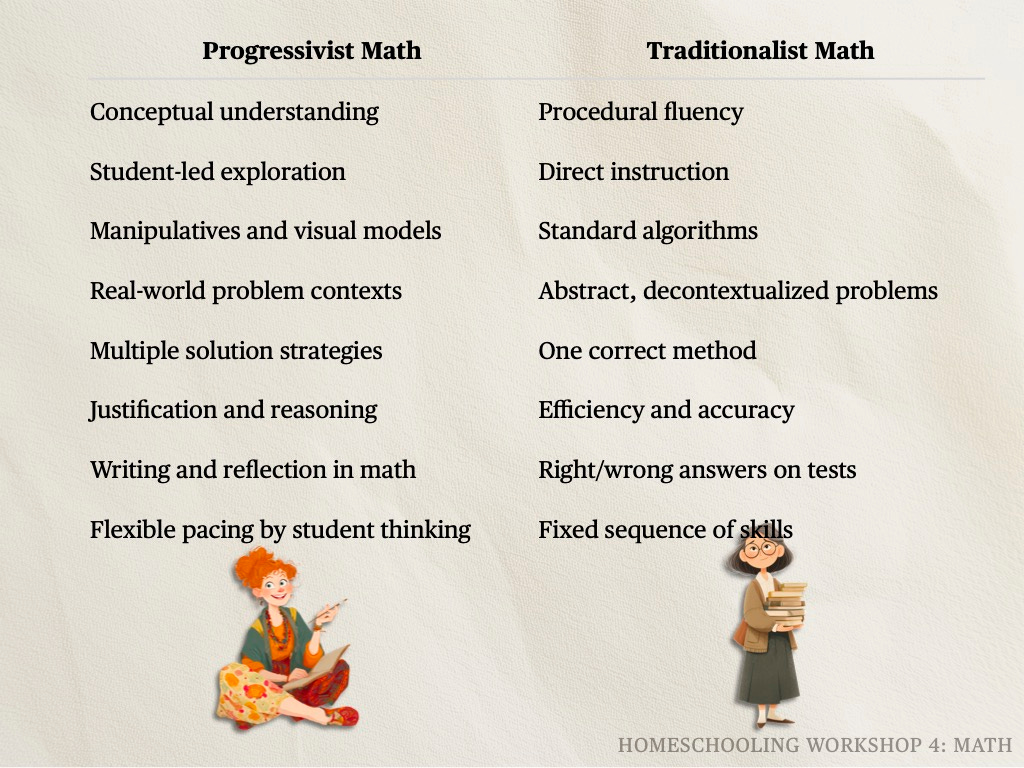
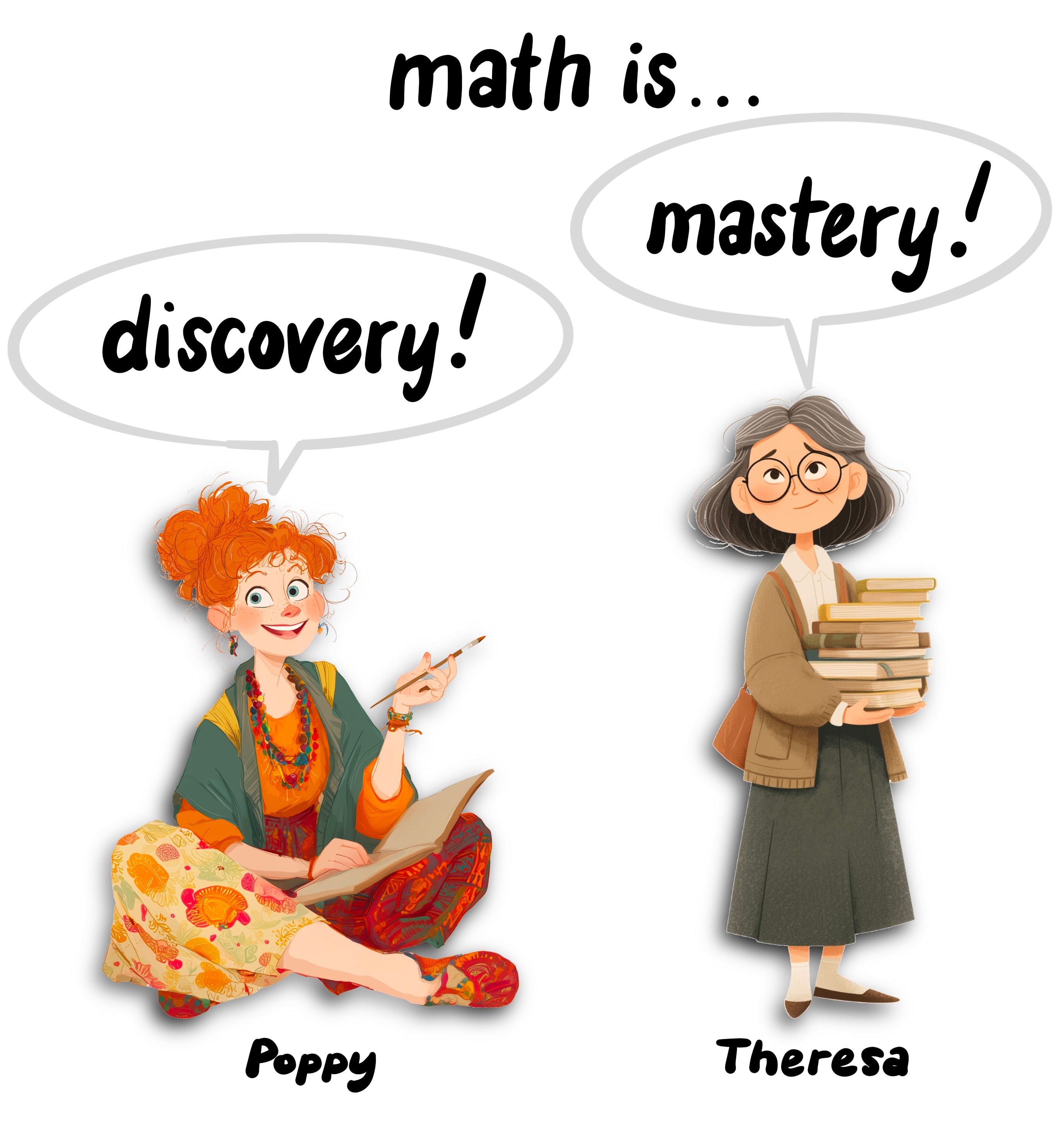
Though if you had to distill what the core of mathematics is, they might say…
We can’t dismiss this fight — important values are at stake; everyone reading this has Opinions. But I want to suggest that while this war rages on, some of the things that matter most are being ignored: the magic of numbers, the power of numbers to wrestle reality into submission, and the possibility that numbers can help us peek into ultimate reality itself.
Imaginary Interlocutor: Slow down; that’s some pretty heady stuff there.
A sign we’re not wasting our time! Each of those will become, in turn, the north star of the three cycles of our curriculum, starting in elementary school (grades 1–4) with “the magic of numbers”.
Through each of those cycles, our math curriculum will follow three threads:
🧵 LESSONS, where we build a wee bit of magic into the foundation of math,
🧵 PUZZLES, where we go wild with that magic in other kinds of math, and
🧵 QUIXOTIC GOALS, where we use all of this to do something crazy (in elementary school: mental math).
Let’s get started. (A note that I’m trying something new today — instead of giving all three of those threads in one post, I’m going to give them one post each. My hope is to make these easier to read. After the third one, I’d love your feedback as to how this is working.)
Elementary math thread 1: 🧵LESSONS
In which we secure math-magic through rather rigorous daily practice.
Parents depend on a school’s elementary math curriculum to keep their kids at (or above) grade level — so anyone wanting to do something new with math needs to first show kids won't fall behind.
The first task of any exciting new math curriculum, then, must be don’t screw this up. Think of this thread as being the serious, risk-averse side of the curriculum.
I.I.: This sounds like the opposite of “enchanted”.
No — “serious” needn’t rule out “magical”. As professional illusionists (and debunkers) know, the real experience of magic comes through diligent work.1
🧵LESSONS, Practice A: Daily Ladders°
A well-made math curriculum is a complex machine, and people have invested their lives into making good ones. Rather than trying to invent our own, we’ll build on someone else’s.
I.I.: Which curriculum will you build on?
If you’re a homeschooler, whatever works for your kid is great. If you’re a teacher, we can help you utilize whatever curriculum you’re obligated to use.
But as we get to recommend curriculums to new schools, our answer is going to be JUMP Math, which (along with geodes, cats, and the first Jurassic Park movie) is one of the world’s few perfect things.
I.I.: I’ve never heard of that one before! What makes it so good?
It’s built on one singular idea — they call it “guided discovery” or “incremental mastery”; I call it Concept Ladders°. In brief: it teaches big new hard ideas through tiny steps by taking kids through those steps (rather than separating the teaching from the doing).
It’s the brainchild of the playwright-turned-mathematician2 John Mighton, who discovered a method of teaching math that could help more-or-less any student build skill quickly.
Say a student can’t figure out:
0.80 + 0.04 = ?
The temptation for a teacher is explain with words. But in math, words suck! Much better to build on our innate ability of 🤸♀️SPOTTING PATTERNS. So instead of explaining, write a simpler question:
0.80 + 0.01 = ?
If that’s too hard, ask a simpler one:
0.8 + 0.1 = ?
If that’s still too hard, then ask a simpler one:
8 + 1 = ?
Let’s call this “stepping down the ladder”. Once you find something related that students can do, start stepping up:
8 + 0.1 = ?
8 + 0.2 = ?
8.0 + 0.2 = ?
The goal in choosing these is to keep the student mental state where the answers come with only a moment of thinking — that magical area between “boredom” and “kicking chairs”. (Educational nerds like to call this “the zone of proximal development”. It’s similar to the experience of “flow”.)
Keep climbing that ladder!
8.1 + 0.1 = ?
0.8 + 0.1 = ?
0.80 + 0.1 = ?
Keeping students in this state is the genius of JUMP’s teacher training program; they’ve built their whole K–8 curriculum around the idea of making this easy.
0.80 + 0.01 = ?
0.80 + 0.02 = ?
0.80 + 0.04 = ?
…and that problem, if you recall, is the original problem the student couldn’t solve.
And this is the magic of daily math ladders — you hit your head against something that seems too complex for you, and then you come back, and realize it’s simple. JUMP makes it easy to make this routine. To make kids care, we need to show that this isn’t merely true for adding decimals, but is also true for fractions, percents, long division, and everything in math. Mighton points out that this, in fact, was proven by Bertrand Russell and Alfred North Whitehead in their Principia Mathematica: all mathematics is decomposable. It’s all one long ladder. There aren’t any gaps.
This is the magic that we want to help kids feel.
I.I.: I’m a bit confused — is JUMP Math part of educational progressivism, or educational traditionalism?
It blends both in the most remarkable way. Unlike old-school traditionalism, it doesn’t spend much time telling kids how to solve problems; instead, it tucks the teaching into the problem-solving itself. And unlike old-school progressivism, it doesn’t give kids much creative room to find their own ways to solve problems; instead, it shepherds them through efficient, powerful methods.
To me, it’s the best of both worlds: it respects kids as agents who need to make sense of things themselves, but doesn’t assume that they have god-like powers to re-invent the corpus of math on their own.
But maybe this isn’t your kid! If JUMP doesn’t float your boat, there are certainly other curriculums that people love. (In our Egan homeschooling group, Beast Academy comes up a lot, as does Minimalist Math and Math Academy.) If your curiosity is piqued by JUMP Math, Zach Groshell’s interview with John Mighton is a great place to start, as are these pieces (1, 2) in The New York Times.
🧵LESSONS, Practice B: Boss Problems°
There’s a problem with doing ladder lessons as a class — kids who already know how to do the problems will be bored. (This is, of course, a problem with teaching anything in a classroom.)
We can solve this elegantly: before teaching each day’s lesson, write down a couple of ludicrously hard problems that kids will be able to do only if they understand the lesson perfectly. Give kids a couple minutes to read the problem, to ask questions about it, and to try it.
Invite any students who get it right to skip right to doing their homework.
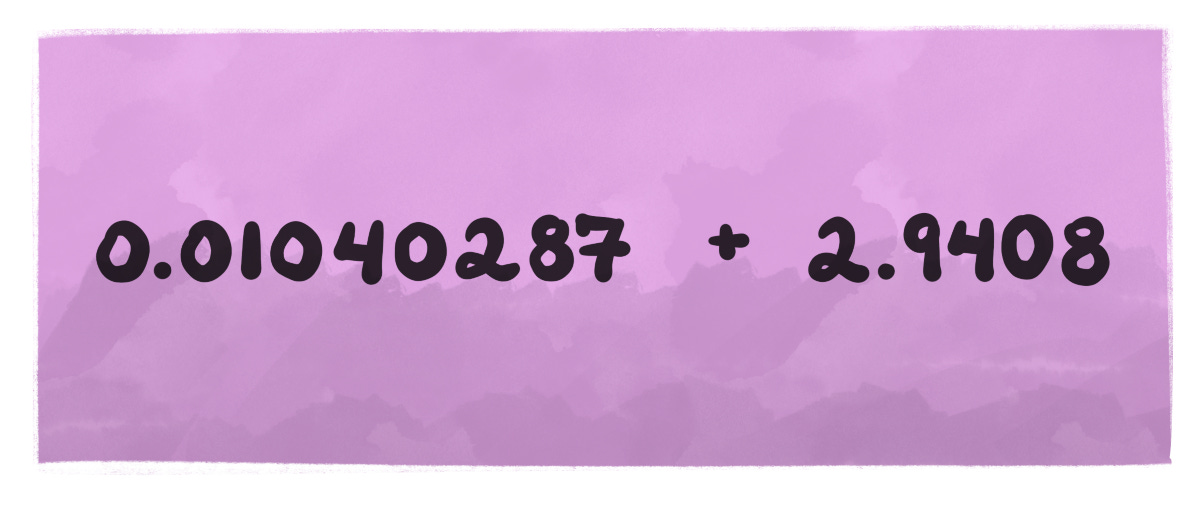
For the math lesson above, such a problem might look like this:
I.I.: Is that actually “ludicrously hard”?
For you it may look easy — but it’ll make many a fourth grader’s eyes bug out. Which is precisely what’s important for a good Boss Problem — it should look hard, but not actually require any cleverness beyond what they’ll learn in the lesson.
And this is the magic of Boss Problems: you take the drama that we talked about above and crank it up to 11. You lead them into experiencing defeat; then you help them experience success. Problems that seemed impossible suddenly seem obvious.
JUMP’s genius is that it makes math easy. Boss Problems’ genius is that they make math hard.
Showing these Boss Problems to kids at the start of a lesson has a huge benefit: now the lesson has purpose. They want to beat that sucker, and understanding the lesson is the key to doing it. (Again and again, I’ve seen kids’ eyes go wide in the middle of teaching, and then see them jump up and run to the wall to try out an idea that’s just come to them.)
We can make the lessons matter even more by repeating this on a larger level: write a special set of Boss Problems on colored paper at the start of a new unit (about once a month). These should presage what they might learn — I based them on the problems in the unit’s final test, but then made them look even harder.
If you’d like to learn more about this, take a look at my old post, Boss Questions°.
🧵LESSONS, Practice C: Making Friends with Numbers°
It’s important to recognize how uneasily numbers fit inside our heads. Until recently, most languages didn’t even have names for anything in the double-digits. Our 🤸♀️NATIVE NUMBER SENSE is paltry. As Kieran Egan quips:
“Our number system is about as good as that of a blackbird’s, but less good than that of some species of wasps.”
I.I.: This sounds like the excuse of someone who’s not going to expect much of their students.
No, the opposite: understanding our innate weaknesses is the first step toward overcoming them.
I.I.: And how can we overcome them?
For a hint, we can look to where math came from historically: numerology.
I.I.: I feel my finger reaching for the “unsubscribe” button…
Throughout many cultures, before numbers were technical things to compute with, they held mystical significance. We suspect that this was load-bearing. In China, odd numbers were yang, and even numbers yin. Across the Near East, 7 was a “heavenly” number — seven planets, seven heavens, seven days of the week. The Pythagoreans swore oaths on the number 10.
I.I.: Oh glory. Are you planning to impose some sort of spirituality on kids?
Nothing like that. All you want is to show how each number has meaning outside itself, and to do that all you need to do is collect links that each has to things in the natural and human worlds. For example:
1 star in the solar system and eye on a Cyclops
2 arms, ears, nostrils, pinky toes, and so forth on most animals
3 primary colors
4 cardinal directions
5 fingers on a hand
6 legs on every insect
7 planets (classically)
8 arms of an octopus, legs of a spider
9 Muses
10 fingers, toes
11 players on a soccer team
12 months in a year, signs in the zodiac, tribes in ancient Israel, hours on a clock face
To keep this collection, you may want a special notebook or cards from 1–100 hanging on a wall. At the top, write the number lightly, and in pencil.
Use the paper to write down links. For the single-digit numbers, you can also sketch in a little history of where our numeral came from — easily found on each number’s Wikipedia page:

After you find two or three links for a number, it's time to 🤸♀️PERSONIFY it. Ask what the number feels like to you. What color does it seem to want to be? What font feels right to write it in?
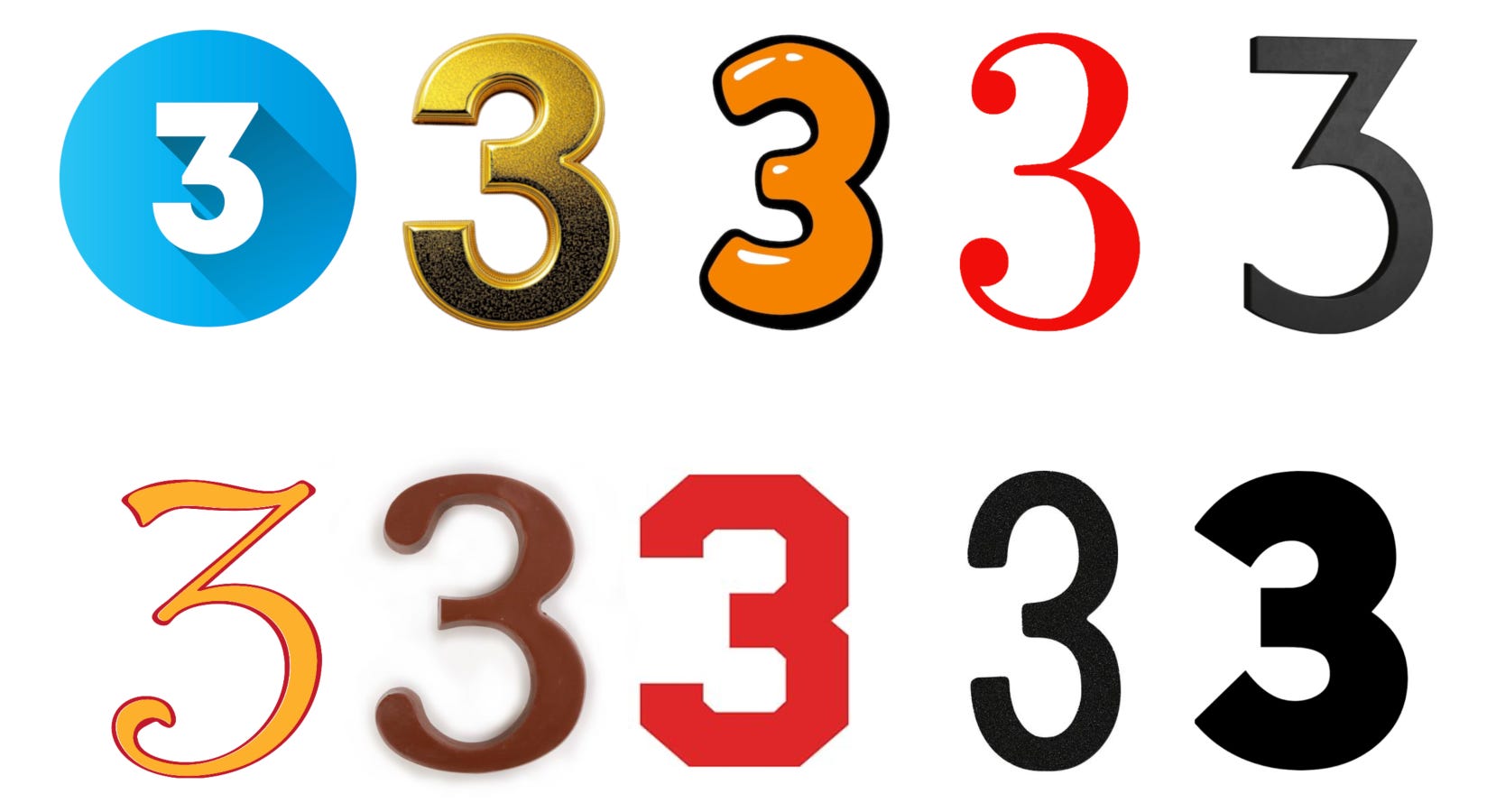
When numbers have feelings, people pay attention to them.
🧵LESSONS, Practice D: Origins Stories of Math°
Now that we’ve made an emotional connection with numbers, let’s turn to the other squiggles we face in math: symbols like +, –, ×, ÷, and =, and the written numerals themselves.
Unlike the numbers, these don’t describe things in the natural world — they’re conventions created by some now-dead person (often a very quirky one) who was trying to solve a problem.
Historians have figured out where all these come from. All we need to do is to turn them into 🧙♂️SIMPLE STORIES, and slip them into our math lessons.
Let's turn back to that initial problem:
0.87 + 0.04 = ?
Squiggles, squiggles, squiggles.
Why is “plus” written as a tiny cross, and “equals” as two straight lines? What’s up with the decimal point? Heck, what’s up with decimal values — why is the “8” in “0.87” ten times bigger than the “7”?
I.I.: That’s a lot of questions, and I don’t want to bog down a lesson.
Three responses to that. First, this can be solved by teaching these stories early, just as kids are learning each of the concepts. That is, when they’re learning addition, they should hear why we use the “+” symbol.
Second, these don’t take much time to learn: a few sentences suffice:
“+” is a lazy way to write the word “and” in Latin — “et”
“3” is just three horizontal lines, swooped together
“÷” was invented by a Swiss professor in the 1600s and we still don’t know why he chose it… but it’s interesting that it looks a lot like a tiny picture of a fraction
But I can’t say the third part emphatically enough: math is stories, too. To do math isn’t just to arbitrarily manipulate random squiggles: it’s (also) to step into a millennia-long tradition. When we forget this, we alienate students from what we’re asking them to do. (No wonder so many people hate math!) When we remember this, we re-humanize the discipline, and make it easier for normies to fall in love with math.
If you’d like to see more about this, take a look at my earlier post, Origin Stories°.
🧵LESSONS, Practice E: The Return of the Bosses°
So much of math that’s learned gets forgotten. This is especially true of the hardest problems that kids struggle with, which is tragic: having put in the work, they’re what students most deserve to remember!
A simple fix: instead of throwing away the Boss Problems, hold onto them. Put them in a box. Each Friday, as you sip your tea and review your Memory Box, pull out one to see if it still stumps them. If it does, great — you created these to be really hard, and this one is a good fit for the kid! Savor that feeling of confusion, and write down more questions on the front of the paper.
Hard problems can become friends, too.
(In middle school, we’ll go deeper into this with our Deep Practice Books°.)
Next up: Puzzles
If we do our job right, the five practices above will make it easy for students to not hate math, even as they stay at (or above) their grade level. But our bigger task is to help them fall in love with math. That’s what the next thread — 🧵PUZZLES — is for.
Be prepared for things to get strange, and delightful. In the meantime, ask questions below.
© 2026 losttools.org. CC BY 4.0
For what it’s worth, Egan was perfectly in agreement with this:
“becoming proficient in addition, subtraction, multiplication, and division, for example, can be achieved meaningfully within curriculum activities that focus constantly on the magical aspects of mathematics. But… we cannot escape the need for a period of quite hard work by children and a need for continuous practice to ensure fluent mastery.”
– Kieran Egan, Primary Understanding, p. 227
Turned actor in Good Will Hunting! Dude gets around.
I have Opinions. 😜😂 I think in some areas, I am more of a traditional/classical homeschooler, like with history. However, when it comes to math, I am full Poppy. Phrases like "rigorous daily practice" and a "need for continuous practice to ensure fluent mastery" make me itchy. I'm curious, does anyone know if Egan enjoyed math? Was he, personally, enchanted with numbers? I feel like if he were the sort of person who did math for fun, he wouldn't have said those words.
Regarding the practices, I LOVE the concept of ladders. The math that I made for my own kids uses this concept, except rather than going through a ladder in a day, for example, the ladders are tackled simultaneously and spread out over the year. Essentially, there's one ladder for each area of math (decimals, fractions, geometry, probability, time, graphs, rounding, etc.) each divided into 36 steps. The kids just do one step on each ladder each week, going back to the previous week or two if necessary. It's like built-in spaced-repetition and, in my opinion, significantly reduces the need for "continous, rigorous practice" which frees up times for math games and other ways of making developing math fluency enjoyable. However they are used, ladders are so effective, because they build confidence in a nonstressful way while letting the student do all the actual mental effort.
I think the "making friends with numbers" and the "origin stories of math" practices are also brilliant. I haven't ever seen those suggestions before, but I love them and wish my kids were younger so it would make more sense for me to geek out on them. I don't know where it fits, but I feel like connected to these practices somehow should also be math metaphors and stories. I'm not sure, but I think they are pretty popular in Waldorf. I don't have a good reference for them unfortunately, but whenever I'm tutoring, I always try to come up with *something* because it makes whatever concept we're working on more friendly and memorable. Here are some examples I can think of off the top of my head:
- Long division - A certain number of people (the divisor) go to the house of Count Divide and hand him their objects that need to be divided among them (the dividend). He takes the objects inside his house, does his calculation, then writes the answer on his roof for how many each of them should get (the quotient). -- This was the first math story I ever saw. I believe it was in Oak Meadow's first grade curriculum that I used over a decade ago. I read it to my then first grader and was like, "this is genius, we'll just do this for everything in math."
- Fractions - obviously, you're going to a pizza party
- Borrowing/Carrying - the different place values are actually apartments for different types of creatures. There are doors between the apartments and they can visit their neighbors, but they have to first transform into the other creature type according to rules, like 10 goobers (single units) makes a doodle (a ten).
- Negatives/Positives - with younger kids I use a squirrel holding an acorn in a tree (positive) or burying it (negative). with older kids, I use money. earn money (positive), borrow money (negative).
- Perimeter - you're a farmer walking around your sheep pen checking for holes in the fence.
- Functions - are factories. You dump in your raw material, X, and some magic happens on the inside and it spits out Y on the other end.
- Solving for the Unknown in Algebra - A number commited a crime and doesn't want you to know who he is so he's wearing an X costume. You have to be a detective and use the clues in the rest of the problem to figure out his real identity.
- Mutivariable equations - You're throwing a party and your best friends get awesome gift bag X while everyone else gets mediocre gift bag Y.
Anyway, Egan was all about stories. I feel like it would be a shame for an Egan math curriculum to not incorporate them somehow when they can be so helpful!
Warmly,
Michelle
I got JUMP Math to have a look at, and although I do see a lot of teaching through doing, I haven't yet seen any ladders or stepping down or up ladders. Do you have a page number or section number that shows it? Is it in the teacher resource or in the assessment and practice pages?