

What would it take to “solve” debate?
A while back, Scott Alexander wrote that he gets pitched on schemes to solve debate:

These attempts, he said, are “well-intentioned, sophisticated, and doomed.” The problem is that they misunderstand why internet debates are so terrible — it’s not logical fallacies, false facts, or bad argument structure. Rather, he argued, it’s because
real disagreements are intractably messy, and
few people actually want to put in the frustrating, painful work of revamping beliefs.
So, he writes, it seems next-to-impossible to organize a community around this.
I suppose this is an awkward way to begin a “Scott is wrong” post, but: I think this is substantially right! But I see a way forward in what he wrote — a way to radically improve the practice of debating people on the internet so that people regularly (semi-regularly?) change their minds.
I don’t have any expertise in formal debate, but my hobbies include befriending young-Earth creationists, arguing with my fellow evolutionists on Reddit, interviewing flat-Earthers, and hosting dinners that bridge political divides. And over the last decade, I’ve been tinkering with new approaches to public debated that actually help the audience change their minds. At the moment, I’m part of a team that’s just finished putting on a series of debates over the Shroud of Turin — the purported burial cloth of Christ, and modern Catholic relic par excellence — and I think we’ve found the seeds of something that might work.
We can’t yet claim to have a scalable model, but if I had to describe our “minimum viable product”, it’s this: (1) pick a juicy topic that a community really cares about, (2) get a pair of people to fight each other publicly, (3) identify a bigger enemy against which they can fight alongside each other, and (4) use Bayes to keep score.
My hunch is that these tactics overcome Scott’s objections — in fact, his critique obliquely points to them. I’ll take them in turn.
1. Pick a juicy topic
Our team came together over the Shroud of Turin.
Imaginary Interlocutor: You’ll forgive my ignorance of Catholic relic-lore, but: what’s that?
The Shroud of Turin is a medieval con — or at least this is the mainstream scholarly view. It’s a forgery of the burial cloth of Jesus; it was fabricated in the 1300s and displayed in a small French church to attract pilgrims and their money.
To me (as you’ll see), the evidence for this seems overwhelming. But famously, the cloth has an eerie, faded image on it:
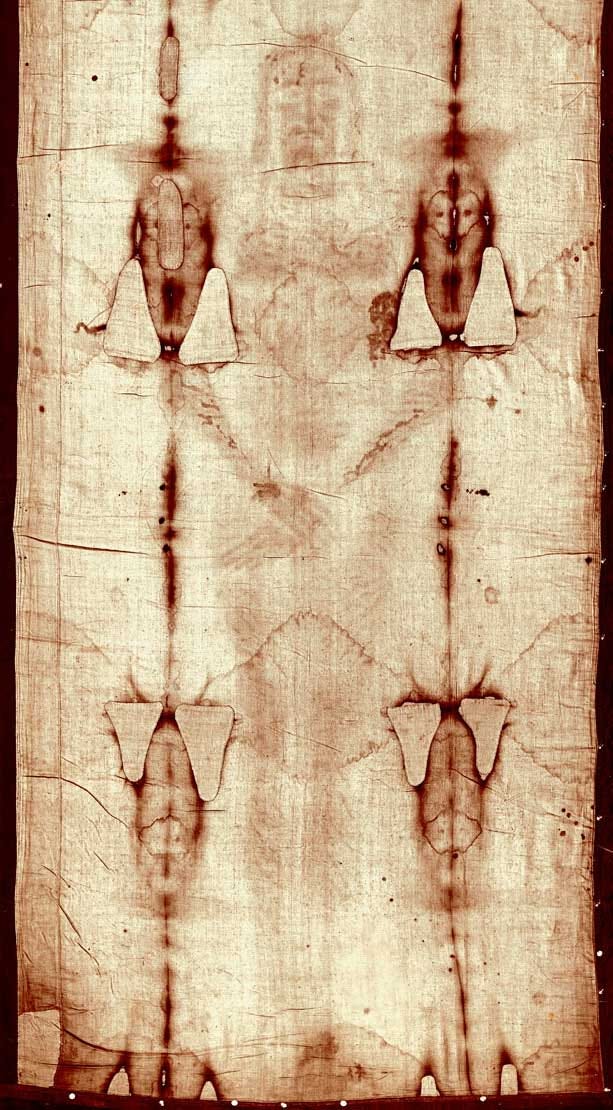
…which honestly does have some interesting properties! It doesn’t, for example, seem to have been painted or printed onto the cloth. The coloration is thin and superficial — less than a thousandth of a millimeter thick — and seems to be caused by a chemical change in the linen’s fibers. Intriguingly, many skeptics grant that it encodes three-dimensional information: that is, the darker areas of the image seem to correlate with how close they would be to a 3D body.
Attempts by skeptics to recreate this image haven’t come particularly close to succeeding: a recent, well-publicized, $1 million contest to replicate the details of the Shroud didn’t even find any entrants.
That’s the skeptical take. The other interpretation is that this is the burial cloth of Jesus himself, whose resurrection created the image. This is forcibly argued by an international community of researchers calling themselves “sindonologists”, from the Greek sindon, “shroud” (hence the colloquial term “shroudie”).
My friend Georges (pronounced just like “George”, it’s French) is a dyed-in-the-wool shroudie, and has taken the other side in these debates.
Imaginary Interlocutor: Why do you care about this? Of all the truly important things in the world that we need to spend time discussing, why waste time on a medieval Catholic relic?
Is this the moment I should point out that ACX has been slowly morphing into the Internet’s central node for diving into Catholic lore? But I think that this debate would have happened without our community’s interesting turn.
One is negative. I’ve encountered forms of traditionalist Catholicism that were catastrophically wrong about history (especially Jewish history) in ways that seemed not just embarrassing, but dangerous.1 My time with fundamentalists taught me that big-belief systems often loosen when people start to question a concrete claim.
On the positive side, I have a crush on Catholicism! I think classical Catholic schooling contains real insights into what a re-humanized education can look like, and I actively support that community. I want to help my Catholic friends become better acquainted with the riches in their tradition — and the Shroud of Turin feels like cruft. As an open-minded agnostic (who spends far too much time thinking about religion), I want to steer Catholics to the best arguments their faith has to offer.
But there are two objective reasons I think the Shroud is a great topic on which to re-invent debate: (1) lots of people care about it, but (2) no one needs it to be true.
The Shroud is having a cultural moment. Joe Rogan has talked about it, it made the Today Show, and it seems to be trending in skeptical debunking circles. It’s even spread into some Protestant apologetics — long thought to be a safe space from “Papist relics”.
And I think this is key for anyone looking to “solve debate”. Scott wrote:
The hardest problem for any social technology is getting users: We’ve talked about this before for dating apps. And if it’s that hard to lure people in with the promise of sex, it’s probably even harder to lure them in with the promise of logical accuracy.
Like dating, arguments require two compatible people. That means your app is useless until it has a big enough population that, whenever someone wants to argue, there will be a compatible person willing to take the other side of that argument in a reasonable amount of time. That’s hard to bootstrap.
Dating apps can only work because they promise passion. Anyone hoping to “solve” debate would do well to recognize that, and start with communities who are already passionately debating a specific topic.
Of course, we don’t lack for topics that people are passionate about! But I suspect there’s a second, somewhat-opposite reason the Shroud is a great topic — it’s not a hard identity marker, like (say) the resurrection of Christ. While lots of Christians can get really charged up about the Shroud, no one is required to believe in it to stay in their community. Most Protestant pastors I know are disdainful of it, but even the Vatican keeps some distance from it: Catholics are permitted to venerate the Shroud, but the Church refuses to officially deem it authentic.
That’s to say, the Shroud is ideal because people care about it deeply, but almost nobody needs it to be true.
2. Find two fighters to gin up the drama
The biggest weakness in the proposals Scott describes is that they seem to mistake humans for Vulcans. He wrote:
The simplest “solve debate” proposal is the argument map. Some technology helps people decompose arguments into premises and conclusions, then lets skeptics point out where the premises are wrong, or where the conclusion doesn’t follow from the premise.
To “solve” debate, we need to more fully humanize it — and that means taking human nature seriously, warts and all. People usually say we want to be rational. We say we want to know the truth. And to some extent, we do! But most of the time, what we really want to see is a fight. We want to see our champion triumph over the enemy. We want to see them humiliated.
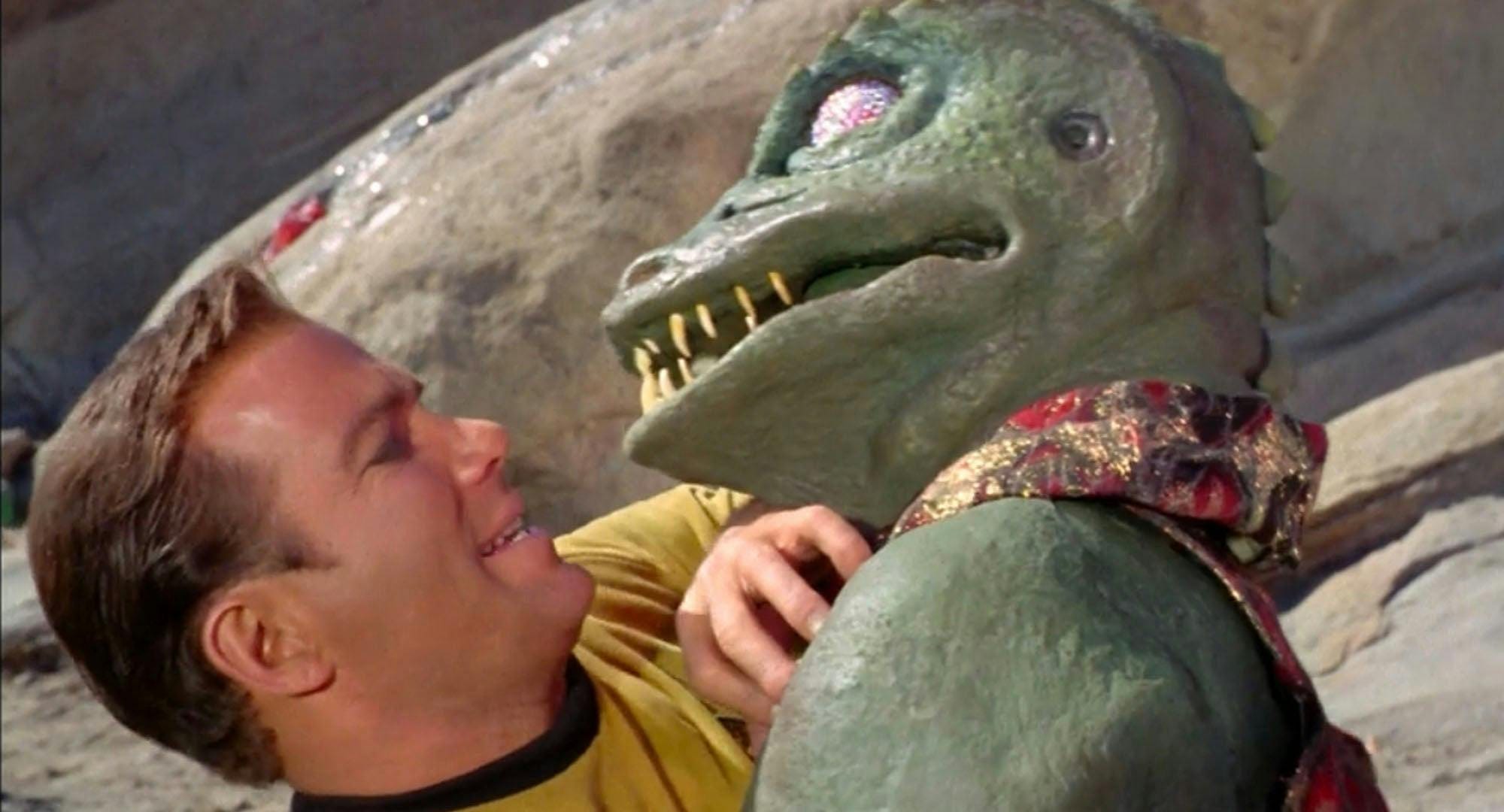
We realized that to re-invent debate, we needed to play up the “fight” part to get people to come to the event in the first place. So we played it like a mashup of a boxing match and the Roman Colosseum. We advertised with this image:
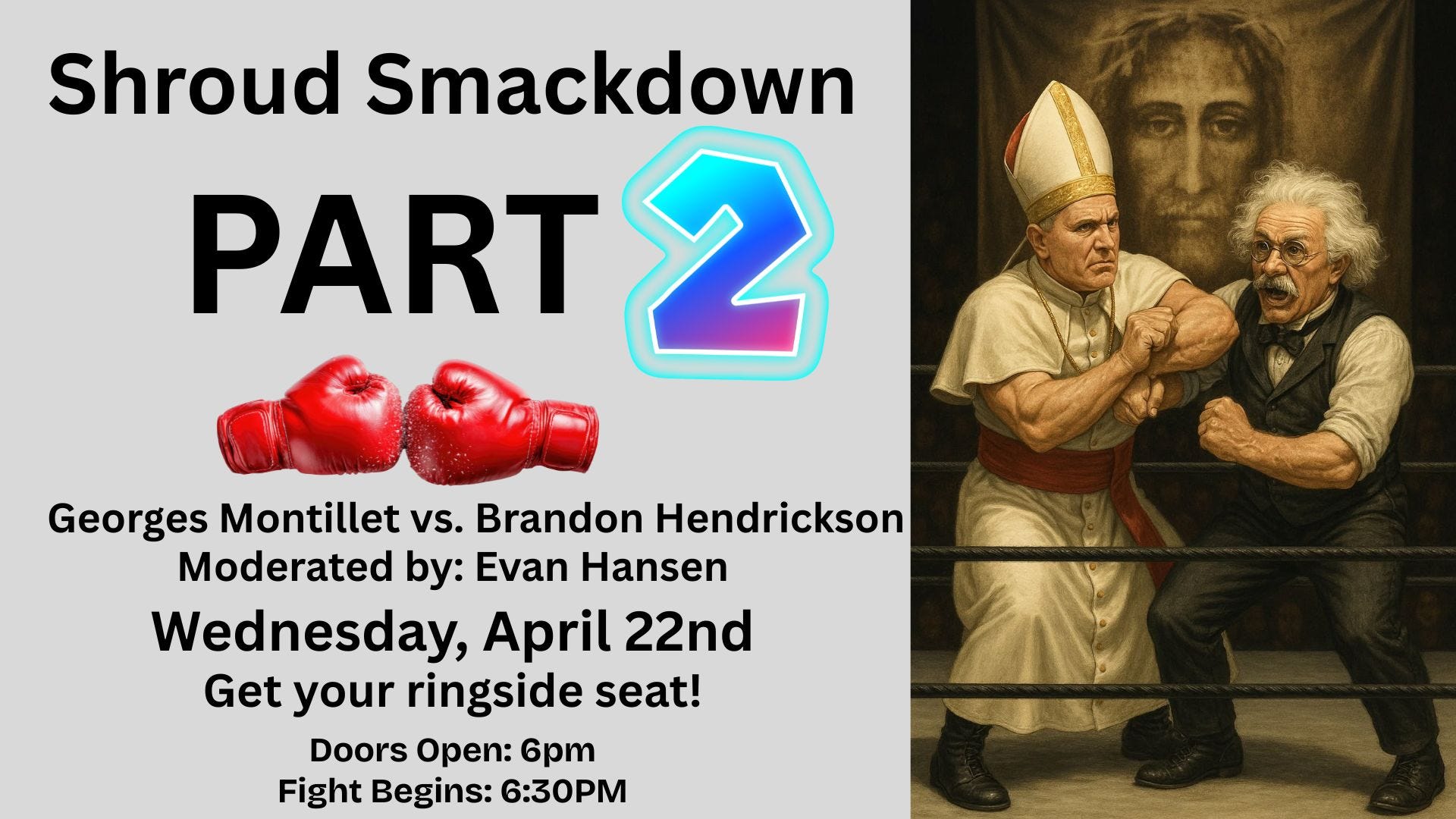
Our moderator kicked off the evening by bellowing LET’S GET READY TO RUUUUUUUMBLE! which would have been inexcusably cheesy except by God he pulled it off. At various points we put the crowd in the position of Caesar, giving us a thumbs up/down to judge how convincing they were finding us.2
The point, for all of this, is to find ways to gin up those passions that are implicit in the debate topic. People want to think, but they need to feel.
Imaginary Interlocutor: I can’t help but notice that you’re betraying all the norms the rationalist community has built up over the years. Politics is the mind-killer — have you not heard?
Bayes is coming, don’t worry! But to sell the methods of rationality to people, they need to feel the need for them. In our next step, we’ll help them feel it — but before that, they need to be able to feel something, anything, at all. Starting with analytic, logico-deductive tools is a self-own. Be more Kirk.
3. Find a bigger enemy to fight together
Having built up the enmity between the debaters, we now need to find a way to pull them together to seek truth — and we need to get the audience to root for it.
I.I.: This is when you embrace your inner Vulcan nature and choose peace?
Heck no — this is when we find a bigger enemy.
This is, of course, one of the classic moves in storytelling. Who allied the Elves, Dwarves, and Men? Sauron. Who reunited Iron Man and Captain America? Thanos. Who got the Starks and the Targaryens to stop killing each other? The White Walkers. (There’s a long TV Tropes page on this.) This works in storytelling because it pulls on some of our deep evolutionary and cultural strings — social psychologists call these “superordinate goals”, which is a particularly bloodless way of saying “a big baddie”.
To capitalize on this, we just need to find something that almost everyone on every side of every debate hates.
Thank God for the dumpster fire that is contemporary civil dialogue!
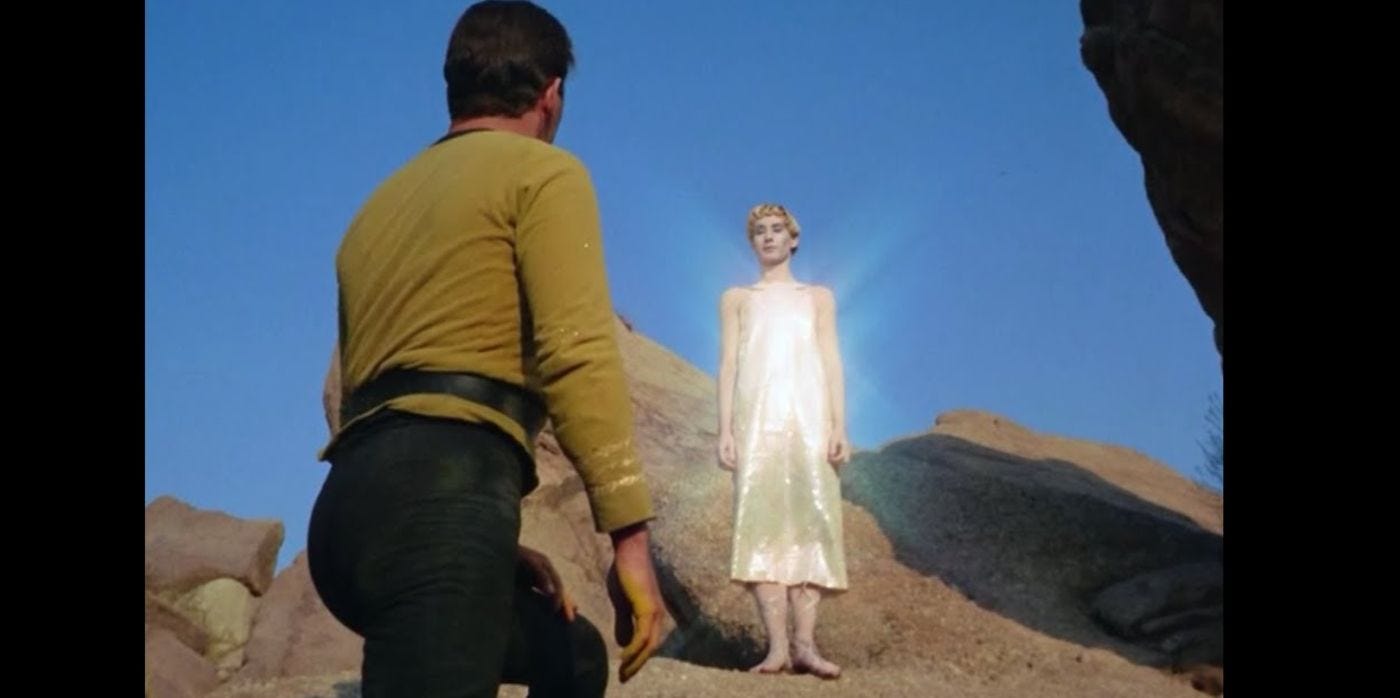
It’s of course fashionable to hate on the things that drive the terrible state of our dialogue: social media, polarizing politics, and culture-war pundits. We leaned into that. We even took potshots at the institutions of “formal debate” that we see: it’s our observation that both sides of audiences often leave a debate more confident of what they believed when they came in.3 This sucks! We defined our events as the opposite of those: we were there to have a real conversation, where we’d help each other steelman our positions.
At every point we could, we flipped the audience’s expectations of our being against one another. Not only did we avoid complaining about the bad actors on each other’s side — we took pains to call out the bad actors and bad arguments on our own side.
I.I.: After ramping up the fighty-ness before, it seems hard to pull off being friends now.
Indeed, which is why it’s so important that Georges and I are already good friends. For five years, we’ve been getting together to walk around town and argue about our respective religious views — and he’s an excellent sparring partner. He has a classical Catholic seminary education, a Ph.D. from Yale, and an open mind. He’s assiduously honest and fair, telling me when I’ve changed his mind about things. Our families have eaten dinner together. I like him heaps.
I.I.: How’s that hopey changey stuff working out for ya?
It’s working great! After the first debate, some members of the audience (ones who had come in very confident of our opinions) expressed that they had become less confident. One guy came up to thank me, saying that he had believed in the Shroud before — and still believed in it now — but that I had given him a lot to think about.
I.I.: But then is the fight fake? Is this just kayfabe?
No, not at all! Georges and I really disagree about the Shroud of Turin (and Catholicism, Christianity, and theism). We drive each other a little crazy. And the topic really does matter to us: if I become more convinced that it’s true, I’ll become more open to other supernatural claims; if he becomes more convinced it’s not, he’ll become less willing to give credence to “scientific” claims in his faith community.
I.I.: I’m having a hard time reconciling these. Are you really trying to beat him, or not?
I want to beat Georges so badly — and, of course, he wants to do the same to me. And, of course, I want to help him do it. “That which can be destroyed by the truth, should be”, and all that. Of all the people I know, Georges is one of my best hopes for someone who can radically change my mind. I want to win about as much as I want to lose.
Our whole relationship is an adversarial collaboration. If we can use this peculiar friendship of ours to help other people become more rational, that’s a cool silver lining.
4. Use Bayes to keep score
I’ve been experimenting with many different formats for public debate over fifteen years; I’m happy to say that they’ve (mostly) succeeded at demonstrating how to argue honestly and civilly and to keep a scout mindset. What those formats lacked, however, was a method to regularly change people’s minds.
For this project, then, I decided to make it overtly, cringefully Bayesian — to boldly Bayes where no one has dared to Bayes before!

I.I.: I see — this is a guest post for ACX, so you think that this needs to be about Bayes’s Theorem! How sweetly autistic of you. You get that all the Bayes worship is a half-joke in the rationalist community, right?
I’ve become convinced that rapid, quantifiable updates are what all debates are lacking.
Without them, it’s almost impossible to pin your opponent down. Even when they concede something, they can go back to arguing like it didn’t matter. Words let you move in an infinite number of directions; numbers force you to go up or down.
Worse, without them, it’s easy for even an airtight argument to be overcome by anecdotes. Humans are vibe-based creatures: we reason in stories and images. Whoever can get the best impression into an audience’s heads usually wins. Bayesian reasoning forces people to cut through all this and be clear about how what they’re saying matters.
On the positive side, rapid quantitative updates provide an excuse to externalize and simplify our thinking. As Scott noted in his post, real arguments are messy (“‘Debate’”, he wrote, “almost never corresponds to mappable arguments”), and yet working memory is limited. We need lots of data to seriously change our minds, and that data can be fit together in an infinity of different ways. It really helps to write out the evidences systematically. (This is especially true when the debaters are bringing in pieces of evidence that the audience has never heard of before.)
But best of all, rapid quantifiable updates gin up the drama of the fight, because they let each person make small wins against the other. When confronted with a good point in the midst of the debate, you can reward that by changing the number you were planning to give — it won’t cause you to lose the debate, and will prove to the audience that you’re honest and trustworthy.
This, actually, led to my favorite moment in our two debate events so far. To describe it, I need to first show the specifics of how we used Bayes to argue about the Shroud in particular. (If you find your heart strangely warmed by neither relic lore nor radiocarbon dating, you may want to skip to #5 below.)
Our specific arguments
Before we fought on stage, we fought over coffee so many times. By the end of this process, we each picked our three strongest evidences for or against Shroud’s authenticity.
My three evidences:
the Shroud was carbon dated by three labs; each reported that the linen was made in the 1300s
the face on the Shroud looks like how medieval artists were depicting Jesus — a narrow face and a long beard
the whole image is front-facing: if it had been created by a blast of radiation (as is often hypothesized by Shroudies), the sides of the body would have colored the cloth as well
Georges’ three:
the many modern attempts to re-create the image have failed; we still don’t have a good hypothesis for how a medieval craftsman could have done it
stories of a cloth miraculously featuring the face of Jesus date back to the 500s at least
the bloodstains on the Shroud match with 80% accuracy with the bloodstains on a wholly separate Catholic relic, the Face Cloth of Oviedo
During our pre-debate coffees, we came up with our own set of updates for each of these. To do that, of course, we had to pull from our butts estimate the chances that each of these evidences would be true in both the world in which the Shroud is Jesus’ burial cloth, and the world in which the Shroud isn’t.4
And then we had LLMs do all the hard work! Here’s how we prompted them:
Reusable Prompt: “Bayes for Normal Humans”
I want to walk through a Bayesian update, but explained in very casual, beginner-friendly language.
We’re going to imagine two possible worlds:
World A — the thing is true
World B — the thing is not true
Before we look at any evidence, we start with a prior belief. That just means our starting guess about how likely the thing is to be true.
Now we look at evidence one piece at a time. For each piece, ask me two questions before doing any math:
In World A (where it’s true), how likely would we be to see this evidence?
In World B (where it’s not true), how likely would we be to see this evidence?
Wait for my answers before filling in the table. If I ask for suggestions, you can offer some — but don’t lead with them.
These are technically called likelihoods, but just think of them as: how expected would this evidence be in each kind of world?
Please keep a running table with these columns:
Step — Evidence — Chance if True — Chance if Not True — Evidence Strength — Chance True Now
After each step show a simple visual meter.
Warnings and coaching: After each step, flag any of the following if they apply:
My numbers seem internally inconsistent or logically confused
I may be double-counting — using evidence that overlaps with something I already entered
My likelihood ratio is extreme (e.g. 100:1 or higher) without an obvious justification
I seem to be anchoring on a conclusion rather than estimating each likelihood independently
Any other classic Bayesian reasoning error worth flagging
Keep warnings brief and non-preachy. One or two sentences. Only flag something if it’s actually worth flagging — don’t add boilerplate caution every step.
Start by asking me what question I want to investigate and helping me pick a prior.
I was shocked by how well GPT and Claude did at this — not just running the numbers correctly, but in calling out reasoning errors we were making (like double-counting evidence) and suggesting numbers that more sensibly matched our models.
I.I.: What were your priors for the Shroud?
We talked a lot about this. We intuited that it would be good for the audience if we came in with a compromise prior — we didn’t want to lose people at the beginning — and I was happy with making it high. We chose 10%.
I.I.: That’s ludicrously high. Surely 10% of other Jesus-related relics haven’t been proven to be authentic.
Indeed — yet honestly, when we repeat this in the future for an audience new to Bayes’ theorem, we’re tempted to just ignore the prior, and let it implicitly be set to 50%. The more we’ve done this, the more we’re convinced that what matters most is helping the audience come along on this ride, and priors are a cognitive hurdle.
I.I.: What numbers did you end up with?
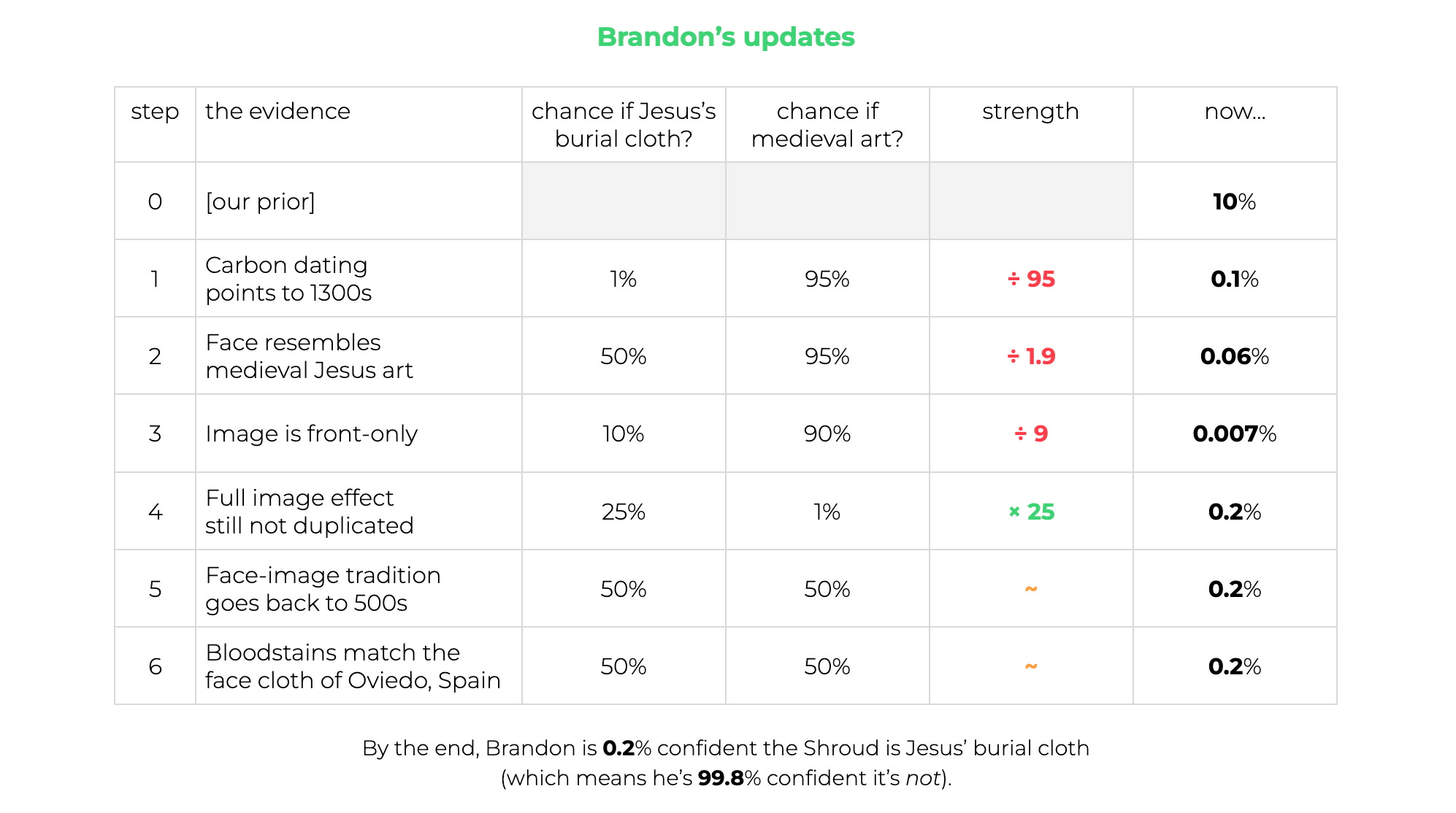
In each of these, I strove to be as generous as possible to the other side. I do have some regrets, though. The technical ones (about my numbers for #45, and my use of the × and ÷ symbols6) I’ll put in footnotes. The more important ones were rhetorical.
First, I made a big deal to the audience as to how almost every piece of evidence should cause us to update in one direction or another — even if only a tiny bit! — and yet for #5, I didn’t update at all. While I don’t think that the story of the Face Cloth of Oviedo is much evidence in favor of the Shroud’s authenticity, I can acknowledge that if there were no story at all about an eerie image of Jesus on a cloth for the thirteen centuries before the Shroud came into the historical record, that would be a significant mark against its authenticity — so that story should tilt me upwards, even if only 51/50 (instead of the 50/50 I gave). That was a missed opportunity to display my openness to the Shroudies in the audience.
Second, I also didn’t update on #6. The reason for this is simple: I’m not yet sure how meaningful this fact is. We brought this evidence into the conversation only a week before the first debate, and I didn’t yet have time to research it. If there really is (as Shroudies say) a statistically staggering correspondence between the bloodstains on the Shroud and the Face Cloth, then this could tilt my final confidence impressively toward Georges’ position. But entering this as a non-update meant that I looked like I was disregarding the evidence entirely — it would probably have been better to put “???” in instead.
I.I.: Any other regrets here?
Yes — I realize now that we shouldn’t have presented these numbers all at once to the audience. It would have been far easier to follow (and far more dramatic to watch!) to see the numbers appear as we debated each piece of evidence in turn.
I.I.: Enough navel-gazing — what numbers did Georges give?
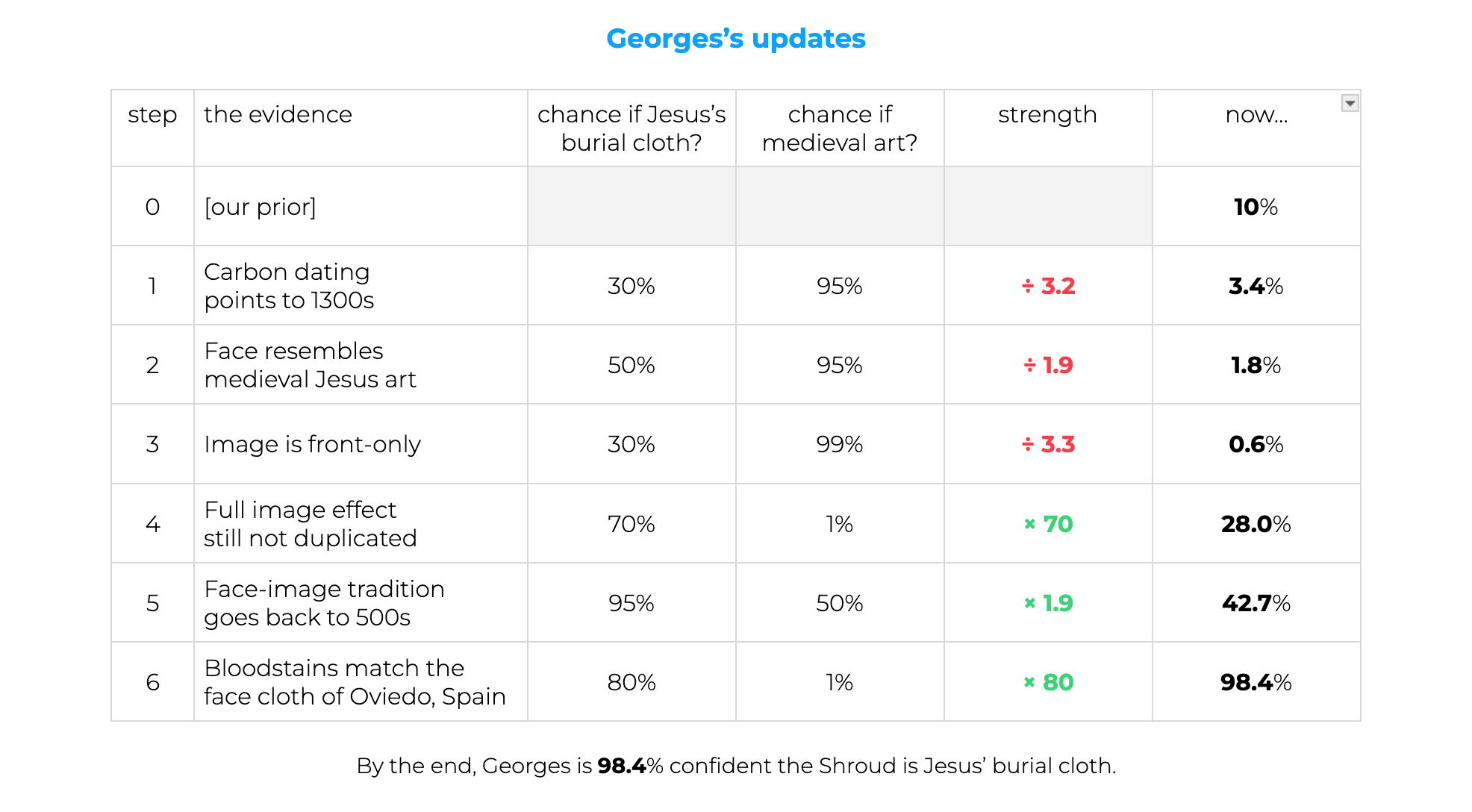
From this, you can see that we’re actually more-or-less aligned on #2, #3, #4, and #5. (This is another great benefit of using Bayes to fight: it helps you cut to the evidences that would actually change your and your opponent’s minds.) It’s only #1 and #6 that really make the difference — which brings me back to my favorite moment of the debates so far.
The best moment of the debate
We decided to focus our second debate on evidence #1, the carbon dating. The debate itself left much to be desired. Whereas the first event was scripted to be fast-paced, in the second we allowed ourselves to go long in our explanations. Much less compelling drama — we’ll be going back to the original model for our next debate. But all the factors I’ve been talking about in this post allowed for something truly rare to happen: Georges updated live on stage.
Shroudies proffer many possible explanations as to why the 1988 carbon dating tests (done concurrently by three separate labs) returned a date in the 1300s.7 They range from fanciful (neutron flux from the Resurrection) to boring-sounding-but-demonstrably-untenable (soot contamination from a fire in 1532).
Georges sees all of these as hopeless, and advocates for what I think is the only defensible possibility: the segment of the Shroud that was snipped out and tested wasn’t originally part of the Shroud, but a patch added in the 1300s. Now, I think there are many reasons to think this quite improbable, but on stage I pointed out an oddity: even if we were positive the snipped sample was from a patch, what are the odds that the patch was from the precise century mainstream historians say the Shroud was fabricated in?
There’ve been 20 centuries since Jesus, I pointed out. The chance that the patch was made in the 1300s would then have a ceiling of just 1 in 20 — 5%.
On the spot, Georges agreed, and flipped that number to 5%. This dropped his overall confidence from 98% to 90%.
To me, this is strong evidence we’re breaking exciting ground with debate. (I have hopes that, eventually, I can move that number down from 5% to 1%, which would drop his final number from 90% to 68% — making him less a Shroudie than a Shruggie.)
5. Against civility
I.I.: This sounds a lot like the wave of “civil conversations” that came around 2017. You know those didn’t work, right?
While I can understand how what I’m proposing might be mistaken for a “civil conversation”, I think that, in the ways that matter, it’s the opposite.
The deepest goal of a “civil conversation” is to show that it’s possible to disagree with someone without hating them. And that’s good! But that means that, in practice, “civil conversations” usually end up being compromises between the poles of honesty and kindness.
The deepest goal of this kind of conversation is to actually change people’s minds, which means bringing together both radical honesty and radical kindness.
I.I.: Isn’t that a mixed message?
No — it’s what’s at the core of every great friendship. We shouldn’t forget that when we argue with someone online about something important, we’re asking them to do something that feels dangerous: open up their own beliefs for public attack. If you want to change the mind of somebody online, step zero isn’t to avoid being mean or nasty, it’s to open up your own beliefs. To get the other side to be vulnerable, you have to become vulnerable yourself. There’s no other way around this.
This vulnerability is hard. It’s perhaps impossible for most people to do with strangers. And so, to power it, we need something stronger. As the good book says:
In the moment when I truly understand my enemy, understand him well enough to defeat him, then in that very moment I also love him.
I think it’s impossible to really understand somebody, what they want, what they believe, and not love them the way they love themselves. And then, in that very moment when I love them… I destroy them.

Which is all to say: yup, I think the secret ingredient in solving debate is love.
Love means truly wanting the best for someone. I don’t just enjoy Georges’ company, I want to help him deepen his Catholicism — and from my perspective, the Shroud is a distraction from the deeper, truer threads of his tradition. Meanwhile, he wants me to experience the joy of his religion. And we both love the truth, and want to change our opinions to match it, even if that’s painful.
Love sounds trite, but Scott’s written about how love may have powered the spread of Christianity. It sounds sentimental, but I’m becoming convinced it’s an acid that can dissolve untruths. It’s the opposite of dunking on your opponents. I will acknowledge that a dunk, done at the highest levels, is a work of art,8 but I suspect that the ultimate effect of most dunks is to harden the beliefs of the people being dunked on. Dunking shows contempt, and the idiosyncrasies of monkey evolution make it almost impossible to adopt the beliefs of anyone who’s shown us contempt.
Love is the opposite of contempt. And yet — as the work of Orson Scott Card reminds us — it can be the more dangerous weapon.
6. But could it scale?
Scott’s right that debate can’t be solved by anything as simple as argument maps or tidy fallacy labels. I nurse a hope that it could be solved by teams of people who can be more Kirk, more Spock, and more Ender — more human.
That’s hard to scale. But it seems worthwhile to imagine what it might look like if someone tried. What would it take?
Create a specific model
My team held these debates locally, which had the advantage of being cheap, but the disadvantage of a limited audience (in each of our three events, we averaged 20 audience members). Since being face-to-face seems crucial for this sort of trusted debate, we suspect that putting up video podcasts on a YouTube channel might be ideal.
Pick an important topic
I wrote above that, to scale, the first adopters of any new method of debate should come from particular communities who are already passionate about a weird topic, and disagree strongly with each other. Some possible topics might be:
the effects of AI on the environment
the wisdom (or not) of effective altruism
prediction markets
geoengineering
AI personhood
animal welfare
renewable energy
NIMBY/YIMBY stuff
Bond with great people
It would take teams of talented people to pull this off. Some specific roles:
a pair of fighters (to fight)
a moderator (to run the debates with both flair and fairness)
a debate coach (to give the fighters feedback on arguing without showing contempt)
a graphic designer and a video editor (to turn the raw video into something professional)
a marketer (to get an audience)
a researcher (to see if this actually works, and conduct experiments in making it work better)
Find a #%@*! name
I’ve spent far too long thinking about this, and have yet to come up with anything resembling a great name for this sort of debate. “Bayesian Brouhahas”? “Anti-debates”? I invite (beg!) any ideas in the comments.
This is all to say, that with the right kind of support, I think that maybe — possibly! — debate could be “solved”. I think we could cultivate debates like this inside many topics that matter. I think that we begin to move the needle toward productive debates that actually change people’s minds.
The odds, of course, seem against it. As Scott pointed out:
This hasn’t worked in two thousand years of arguing
But consider the potential payoff. History seems to be careening toward something like total epistemic closure: groups living in their watertight fictions, trained by their beliefs to feel even the mildest rebuke as an existential threat. The chance to “solve” debate seems to be worthy of some serious attempts.
Note: I’ll be at Less Online next week, where I’ll be doing a break-out group about how debate might be “solved”. Fingers crossed, I’ll be joining Ross Richey (the original creator of the fantastic Astral Codex Ten podcast, and the author of the Substack We Are Not Saved) to do an example round of the format I’m sketching out here. I’d love to connect there with anyone who’s interested in all of this. Also, the comments!
Two notes on doing (and teaching) Bayes
In these debates, I needed to explain Bayesian reasoning to our lay audience — a bunch of Shroud-curious folks who included everyone from Mayo Clinic research scientists to high-school dropouts.
While working on these debates, I was called upon to explain to our lay audience what the hell “Bayesian reasoning” is. To do this, I drew from a post I wrote last year —
I stand by everything in that post, except
it hid the most important point about Bayesian reasoning in an implication near the end, and
it didn’t actually teach Bayesian reasoning.
I’d like to share my screw-ups in explaining Bayes for anyone in the community who’s called upon to teach this topic.
Screw-up #1: Get clear on the social use of Bayes (Don’t do Bayes alone)
I wrote:
Drawing little rectangles is a great way to see where you disagree with somebody. You think aliens have infiltrated the world’s governments? Cool! Let’s talk priors, and see where we draw our vertical lines. You think you saw a ghost, and now it’s rocked your worldview? Let’s talk about how strongly we should update from personal experience. Get a napkin — let’s draw some cute boxes.
This, I think, is actually the deepest value of teaching kids Bayes: it’s a way to get them to converse with people whose views they think are stupid. And it’s only through actually doing that that we have any chance of helping people become rational.
I see now that this isn’t nearly strong enough. Three summers of doing Bayesian reasoning with kids has taught me to say this plainer:
Don’t do Bayes alone.
You’re as likely to screw it up or end up magnifying your previous errors.
Bayes is for pairs of people who disagree with each other.
Screw-up #2: Don’t assume the fundamental move of Bayes is intuitive (Hop in a cardboard box)
Also in that post, I created a toy example of Bayes’ boxes, involving math teachers, NFL quarterbacks, and a perfectly-spiraled football. And it was fine… except that it didn’t actually teach the counterintuitive, essential move of Bayesian reasoning: quantifying belief.
This (so far as I understand it) is the thing that divided the Bayesians from the Frequentists in the mid-20th-century. And the move to doing it well requires a leap of imagination that (I can now report!) strikes many people as deeply weird, and sometimes even morally icky: you have to imagine you’re in a world where the other side is actually correct.
The best way that I’ve found to do this is to embrace the absurdity of it all, and invite people to fly with you in a cardboard box to another world:

If anyone has any other tips as to how to explain Bayesian reasoning to a lay audience, or any critiques of this, I’d love to hear ‘em. And if you’d like to watch the debates, they can be seen here.
Once, when attending a speech by rad-trad Catholic influencer Alexander Tschugguel, I asked about religious freedom. “Ah,” he said, “we need real religious freedom — like the Jews had in the Middle Ages!”
Just as a pedagogical point, this is gold: a simple and criminally underused way for an audience to give immediate feedback to a speaker. It’s even better if you turn it into a slider.
Does anyone know if there’s any evidence for or against this?
To simplify this for our audience, Georges suggested we squeeze the many possible non-Resurrection origin stories of the Shroud into “it’s medieval art”. Though I had my qualms with this at the time, I can now agree that this was totally the right move for these events.
Evidence #4 is about the full image not being duplicated. For that, I gave numbers of 25% (burial cloth) and 1% (medieval art). Georges and I agree that this is the major evidence in favor of the Shroud’s authenticity. Yet my choice of 25% is bizarre — why not higher? My reason for such a low number is that we have no a priori reason to expect that Jesus’ resurrection would create any image on a cloth. The Gospels, for example, don’t mention one. Frankly, I do think this is a deft bit of reasoning, but my choosing a low number here didn’t convey that to the audience at all.
I used the × and ÷ symbols to communicate Bayes factors. To be fair, in many circumstances (especially with very low probabilities), a Bayes factor does approximate multiplication and division. But for an arcane math reason (i.e. you can’t have a probability higher than 100%) they’re computed a bit differently. I’m presently at an impasse — I sense that the Bayes factor is very helpful for a lay audience to see, but I don’t know a better way to convey it than with the × and ÷ symbols. If anyone has an idea, I’d love to hear it in the comments.
More specifically, between 1290 and 1360, with 95% confidence. (Much more specifically, this is two separate ranges: 1262–1312 and 1353–1384, due to the vagaries of carbon in the atmosphere.) I simplified this to “the 1300s” so the audience could track it.
Just sticking to Shroud stuff here, the YouTube channel of Bible scholar Dan McClellan has a series of captivating dunks on Shroud of Turin pseudoscience.
Naming suggestion: "Bayesian Persuasion".
I’d love to do such a debate with you, if we could find an appropriately juicy topic we disagreed about. Perhaps I could take the “pro” side on “Can AI be conscious?” :-)