


In elementary school, we leaned into kids’ storytelling superpowers to plant ~100 history stories in their heads. In middle school, we leveraged their emerging angsty obsessions to make those stories bigger and more ethically complex.
But what we want to do, of course, is prepare adults who can help mend the world. So in our high school history curriculum, we’ll be helping students see the biggest, deepest things about the human world.
So far, we’ve built our history curriculum on two threads:
🧵 A memory palace
🧵 Stories
Let’s see how these can evolve in high school.
HS history thread 1: 🧵Memory palace
🧵Memory palace, Practice A: Murder board (scholar’s edition)°
In elementary school, we made a Memory Palace°, and in middle school, we used it to play the Murder Board Game°. Now we’re going to keep playing that game, but make the questions about historical forces. For example, you can start by asking students to stand in their memory palace and point to stories that feature one of the following:
socioeconomic class
gender roles
religion
the environment
cultural values
law
war
technology
Marxist interlocutor: You fool! ALL stories involve class!
Actually, I’m not going to disagree with that one. This is a profound insight — in fact, it’s so profound that we want students to have it for themselves. As soon as they realize it, they’ll start “winning” the game. That’s our cue, of course, to make the game harder by asking for more specific connections. Just to take “class” as an example, ask students which stories feature…
a violent uprising
someone moving into a higher class
a society whose class system is more (or less) rigid than our own
Former Religious Studies Major: You fool! ALL stories involve religion and cultural values!
Environmental Lawyer: Also the environment! And don’t forget the law!
Yes, yes, you too. All these things we call “historical forces” tend to be present more or less everywhere, at all times. The point of the “scholar’s edition” of the murder board is precisely to help students learn to use these forces as lenses to see what’s going on beneath the surface in the stories.
Politically Moderate Interlocutor: Are you trying to make kids into Marxists?
If I were wiser, I’d answer that with a clear “no”. Reality, however, is more complicated. Wait until the end for the real answer; it’ll help to first see what we’re doing with stories.
HS history thread 2: 🧵Stories
In elementary school, we planted Simple History Stories° into kids’ heads. In middle school, that practice split into two: one that zoomed out to the whole society, and one that zoomed into specific characters. These’ll evolve further in high school to help kids see the world with 👩🔬BIG IDEAS.
🧵Stories, Practice A: History’s biggest questions°
This is an evolution of middle school’s Explore a Society°, in which we looked at one of elementary school’s Simple History Stories° and asked what bigger narrative this is part of. Now, we’ll be connecting multiple stories together, and discovering some of the biggest processes that those narratives are part of.
To do this, we’ll be leaning on the PHILOSOPHIC tools of the 👩🔬SEARCH FOR AUTHORITY & TRUTH, 👩🔬GENERAL SCHEMES, and 👩🔬PROCESSES.
In short, we’ll help students fight about some of the same things scholars fight about. There’s a recipe for this:
present them with an epic question,
show them how scholars have answered the question in very different ways, and
help them form (and defend) their own answer.
I.I.: What sort of questions qualify as “epic”?
For any important historical topic, there are questions that stir controversy. We’re not looking for technical historical questions; those can remain the territory of academic historians. We’re looking for things which (1) serious scholars have debated, and (2) still can get a rise out of people on the internet.
slavery: what explains why some societies enslaved people, and others didn’t? Was the abolition movement driven by economics, or moral ideals?
technology: was the Agricultural Revolution (aka “the invention of farming”) good, or bad?
imperialism: did the Pax Romana actually bring peace to the lands they conquered? Why did Europe take over the world, rather than, say, New Guinea?1
religion: why did Christianity take over the Roman Empire? Why did Islam take over southwest Asia? Is America a secular country?
philosophy: what caused the near-simultaneous development of Greek philosophy, Buddhism, Jainism, Confucianism, and the Hebrew prophetic tradition?
economic progress: Why did the world suddenly get rich around 1800? (Was it capitalism?)
I.I.: Do we really have to have kids fight?
Yes: 👩🔬IDEA FIGHTS are the fundamental way that modern, academic, PHILOSOPHIC understanding happens.
But probably this is too abstract. Let’s take, for a specific example, one of the biggest questions of history: why Europe? Why did Western Europe in particular leapfrog all other regions in technology, economics, ideas, and military? How was it this small, backwater isthmus of Eurasia that ended up taking over the world?
Phase 1: 💥 Orient
You might start by writing down that question, and stick it in an envelope. Have the students try to guess what you wrote, and give clues. Walk through the memory palace, and point to events that touch upon this pattern of “Europe takes over” —
🟣 space 11, dot 1: Columbus
🟣 space 13, dot 2: Galileo
🟣 space 14, dot 4: Newton
🟣 space 15, dot 1: Darby kicks off the Industrial Revolution
Or give them a map with the key removed, and have them guess what the colors stand for:
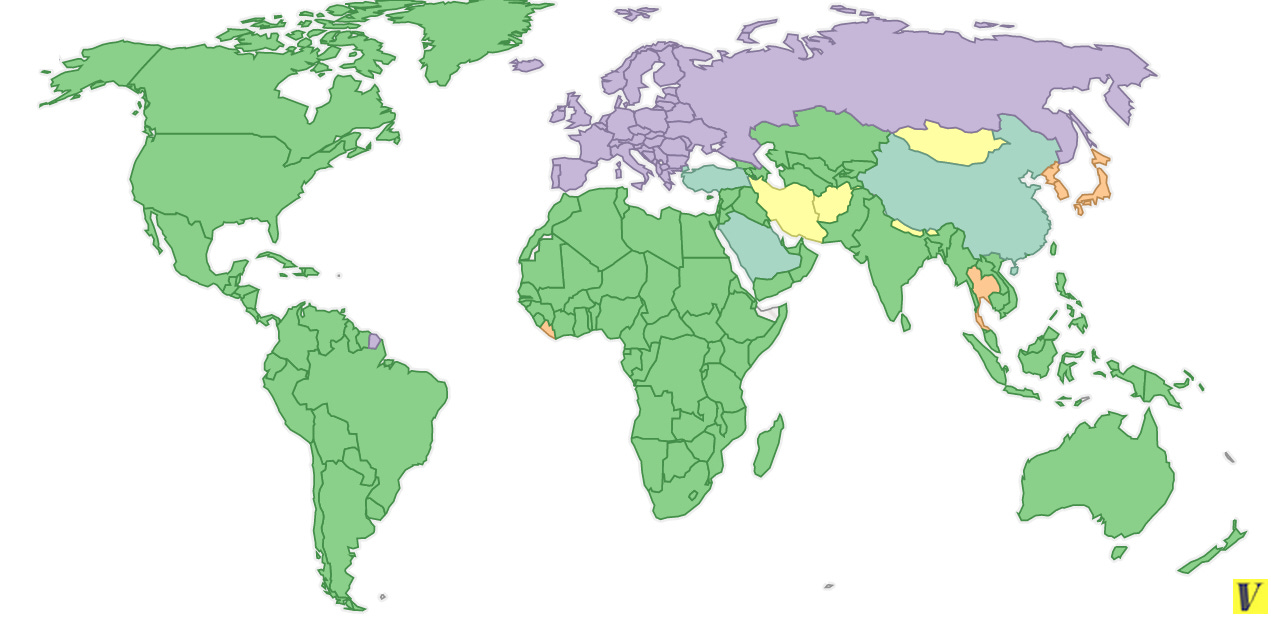
Give as many hints as kids need to guess the question. Throughout, present the question as something that matters — one whose answer (if we only understood it) would help us fix what’s wrong in the world.
Phase 2: ⚠️ Complicate
Read snippets of scholarly works that answer the question in radically different ways. For example:
Max Weber’s The Protestant Ethic and the Spirit of Capitalism: It’s the religion, stupid — Calvinism prompts people to work out the proof of their salvation by getting rich
Frantz Fanon’s The Wretched of the Earth: It’s the violence, stupid — Europe’s system of colonialism terrorized other societies into submission
Jared Diamond’s Guns, Germs, and Steel: It’s the environment, stupid — Europe’s native domesticatable animals allowed for more tech development
Joseph Henrich’s The WEIRDest People in the World: It’s the psychology, stupid — the Church’s marriage rules break the clans, and make Europeans oddly individualistic
I.I.: Is there any place for reading whole books, here?
Probably not here — the thrust is to show a diversity of answers to a big question. Because of this, typically, short excerpts are our friends.
Phase 3: 🐛 Transform
Now the student joins the fray! They need to choose a scholar whose thesis they’ll support, or forge their own path. However they choose, they’ll need to make their argument strong by navigating evidence, employing logic, and pulling in specific historical details. (Good thing they’ve been working with detail-strewn historical stories for a decade!)
As usual, we want students to make something in this phase. The classic project at this level is 👩🔬FORMAL WRITING — the much-hated five-paragraph essay — and now would be a great time to master the skill of writing them.2
Phase 4: 🪢 Integrate
As usual, make a memory card. A simple format would be to write the big question (and a list of some of the thinkers) on the front, and to distill what they each said on the back.
Sometimes, though, students will learn something profound about life.3 When they do, that warrants a memory card.
🧵Stories, Practice B: See history like a scholar°
This is an evolution of middle school’s Judge a Character°. There, we zoomed into the private, inner lives of the main characters from the elementary school Simple History Stories°. Here, we’ll be similarly zooming into the stories, but to see what scholars say is really going on.
I.I.: What makes scholars special?
Brilliant scholars in the humanities and social sciences don’t only have a high IQ or know lots of details. They’ve mastered many concepts which, once you know them, can help you see how things really work.
So to do this, we’ll be leaning on the PHILOSOPHIC tools of 👩🔬PROCESSES and 👩🔬CONCEPTS.
Usually, these concepts are held back until upper-level classes in college. But they’re powerful tools that everyone can learn. Here, we’re going to introduce some powerful concepts, and use them as lenses to see into what students spent eight years learning.
I.I.: What particular concepts are you thinking about?
The foundational ideas of each academic discipline — big ideas which, if true, change everything. Just to name a few:
Economics
Smith’s “invisible hand”: self-interest counterintuitively benefits everyone4
Hayek’s “price signals”: markets process information better than any central planner
Ricardo’s “comparative advantage”: everyone (even the less capable) benefits from trade
Political philosophy
Hobbes’ “social contract”: governments exist because anarchic life is nasty, brutish, and short
Gramsci’s “cultural hegemony”: those in power make us want to be ruled
Machiavelli’s “virtù”: effective rulers must be willing to do what morality forbids
Psychology
Freud’s “unconscious”: our behavior is caused by hidden mental forces
Bowlby’s “attachment theory”: our early bonds permanently shape our emotional lives
E. O. Wilson’s “sociobiology”: we can understand our behavior more clearly once we understand that we’re a type of primate
Sociology
Marx’s “conflict theory”: society is an artificial system of oppression
Durkheim’s “functionalism”: society is an organic system where each part serves a purpose
Said’s “orientalism”: we create distorted stereotypes of other cultures to justify oppressing them
To see how we can use them, let’s work through one example in depth. We’ll take our story of Caesar crossing the Rubicon (previously discussed in elementary school and middle school), and show how using Gramsci’s theory of “cultural hegemony” helps us see something big and new in it.
Phase 1: 💥 Orient
We want to help students feel how much Gramsci’s “cultural hegemony” matters… which calls for a 🧙♂️MYSTERY and a 🧙♂️STORY.
You might tell the students that you’re going to revisit Julius Caesar to spot something no one had noticed before. Together, ponder a mystery: if Caesar broke the law, why didn’t the Senate just arrest him?
Then briefly tell the story of someone who had an insight that might help us answer that question clearly:
Antonio Gramsci grew up poor and sickly in Sardinia but became one of the twentieth century’s most thoughtful Marxist thinkers. Watching revolution after revolution fail in Western Europe, he asked a simple question: why don’t people rise up against systems that dominate them?
In prison under Mussolini, he developed his answer — power survives not mainly through force, but through hegemony, shaping culture and “common sense” so that being ruled feels natural.5
Then ask them: how might Gramsci tell the story of Caesar crossing the Rubicon?
Phase 2: ⚠️ Complicate
Here, tell students that to answer that question, they’re going to need to understand Gramsci’s idea clearly, and revisit what they learned before about the end of the Roman Republic.
I.I.: How can I help them understand “hegemony”? I’m no Marxist scholar.
No problem — Gramsci was, and was a fairly clear writer! A surprising number of the people who gave birth to the big ideas were. You can pluck some samples from Gramsci’s prison notebooks.6
This, by the way, reflects a major piece of our high school reading curriculum: reading important, real, primary sources. But they’re hard! To get students into reading him, you might start with a romantic quote:
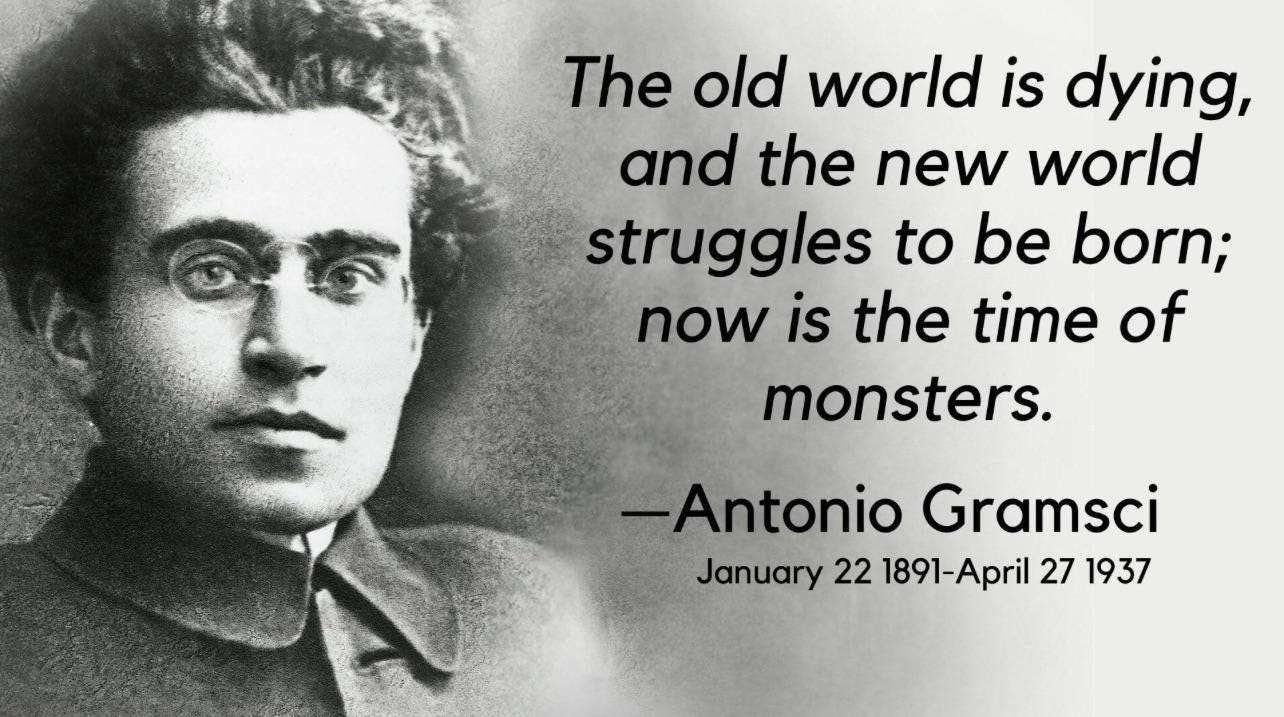
To build to reading his actual work, you might segue to one of the YouTube videos on his theory of cultural hegemony.
I.I.: How should they revisit what they’ve previously learned about Caesar?
Re-read the original elementary story of Caesar crossing the Rubicon and whatever work students made in middle school around it.
I.I.: Egad, does that mean we need to save everything that kids do?!
The details of this need to be worked out. We should be clear about the challenges that come with leaning on a continuity of materials: what should we do, say, with the students who enter a school in high school?
But we should be clear about the failures of any approach to education which doesn’t even try for this: students are doomed to forget nearly everything they learn. Worse, when education is a “conveyor belt” — when the physical objects students learn with are whisked away to never be seen again — the meaning drains out. Revisiting old things, and making them useful again, is the cheapest way to build epic meaning.
Which is all to say that when kids work hard to make and learn things, we owe them the honor of helping them retain it.
Phase 3: 🐛 Transform
Here, as usual, we’ll make something. We can see two obvious options.
You can re-tell the story of Julius Caesar, putting Gramsci’s “cultural hegemony” at the center. For example:
For generations, the republic had been run by a small group of senators who believed the state belonged to them. The system endured because most people accepted that this was simply how the republic worked. But after years of broken promises, ordinary people had quietly begun to stop believing. While the old order still held, it had already lost the hearts of its rulers. The republic had always depended on something invisible: the shared beliefs among its powerful actors that its rules were legitimate.
On a cold day in early January, Caesar summoned his loyal followers and spoke to them of betrayal — how his enemies in the Senate had stripped him of his command and threatened him with prosecution the moment he became a private citizen again. The game, he told them, was rigged. The senators were not defending the Republic; they were using its laws to destroy him and to keep their own hands on power. Then he bade his followers to cross the sacred boundary.
At that moment, in the capital, the Senate was in session, doing the formal business of the state. When they heard the news, the senators fled to safety. It was a rupture of the unspoken beliefs that the centuries-old order had been built on. Many called it treason. But Caesar wasn’t arrested, as he commanded the hearts and minds of too many of the citizens.
The sacred constitutional order, it turned out, had been weakening for decades — the political elites just hadn’t noticed how far it had gone. But Caesar had. He had seen that rules only held when the elites stood together to defend them, and that the republic’s ruling class had already fractured.
(Note that that story was done with some help of AI… but also note that it contains a carefully-laid Easter egg. Hint: what story is it actually telling?7)
Or, instead of telling a story, you could write a formal essay, explaining in a more analytic way how Gramsci’s idea does or doesn’t help us understand the story of Caesar. For this, you’d want to use the tools of 👩🔬ANOMALIES, looking for details that don’t match Gramsci’s claims. (Doing a debate here, too, would be excellent.)
Phase 4: 🪢 Integrate
As always, you want to cap this off with a reflection on what was most important. Here, the focus should be on the big idea that was learned.
The end
Politically Moderate Interlocutor: Are you looking to turn all students into Marxists?! 🫣
tl;dr: no.
But the real answer is a bit more complex, because
A real history education is inherently dangerous.
If you study the humanities seriously, you’ll encounter ideas that are powerful and seductive. You’ll meet (and fall in love with) thinkers who make everything you see suddenly snap into focus. Marx (and his follower Gramsci) is one of those. So are Adam Smith, Steven Pinker, bell hooks, and a hundred others.
This isn’t a bug in a humanities education, it’s the friggin’ point.
Many approaches to education try to make the humanities “safe” for students by steering them toward what they see as the “right” ideologies. But this (1) usually doesn’t work, (2) makes the humanities boring when it does work, and (3) puts students at risk when it does. When people encounter these ideas later, without guidance, they’re far more likely to fall under their spell.
The safer path is the path of exposure. When students experience many ideas pulling them at once, a remarkable thing happens — they begin to build resistance. They begin to instinctively look for blind spots. They begin to ask harder questions. And they begin to use others’ theories to build their own models.
Guiding students through this process is an important part of a high-school history teacher’s responsibility. We want to introduce students to as many compelling ideas as we can, and to help them feel the pull — and then, when they’re half-bewitched, to help them see the holes in the idea.
Our hope, thus, isn’t that students graduate high school as Marxists, anti-Marxists, or any other kind of ideological soldier, but as something better: adults who can think historically, weigh ideas carefully, and use them to help mend the world.
© 2026 losttools.org. CC BY 4.0
To take a country entirely, totally at random.
The classic guide here is Gerald Graff and Cathy Birkenstein’s They Say, I Say: The Moves that Matter in Academic Writing. It’s a simple and elegant book, and would gain power by being yoked with this sort of history curriculum.
At the end of his freshman year of college, a young Kieran Egan was asked by his RA what the most important thing was that he had learned. He responded, “Anglo-Saxon law”. No, the RA corrected, what was the most important life lesson? “I know”, responded Egan. This is a good example of 👩🔬MOVING FROM TRANSCENDENT PLAYER → HISTORICAL AGENT.
A good rule of thumb, as you can see from these links, is that most proper “big ideas” have a Wikipedia page devoted to them.
This short story was written by ChatGPT when I prompted it to tell me the story of how Gramsci came up with his idea of “hegemony” in a few sentences.
Suggested: the section “Observations on certain aspects of the structure of political parties in periods of organic crisis” and “Caesarism” immediately afterwards, and then the short, famous section “‘Wave of materialism’ and ‘crisis of authority’”, which includes the famous lines:
If the ruling class has lost its consensus, i.e. is no longer “leading” but only “dominant”, exercising coercive force alone, this means precisely that the great masses have become detached from their traditional ideologies, and no longer believe what they used to believe previously, etc.
The crisis consists precisely in the fact that the old is dying and the new cannot be born; in this interregnum a great variety of morbid symptoms appear…
Which obviously has no relevance for our historical moment at all.
Hint: how else can you spell “capital”?
I really, really love the hidden wisdom you've embedded within the history memory palace game like a D&D trapdoor under the rug. We really want people to be thinking the intellectual equivalent of "What's under the rug?" much more often.
Oh. That's your cultural bedrock. Not that the world or people are good -- or bad. But mendable.
Ork Ork.