

1. A problem
We’re more like bats than we imagine: we make quite a lot of sense of the three-dimensional world through sound. Yet school jumps to teaching about the physical world through concepts — which gives you so much less information!

2. Basic plan
Set aside time when you encourage kids to make noise with objects — tap them, rub them, thwack them, blow on them. Especially, help them make noises with their own bodies. Help them pay attention to the noises these things make back.
3. What you might see
Classrooms filled (at certain times! not always!) with the joyful noise of kids exploring the acoustic properties of objects. Students tapping, rubbing, and thumping a watermelon to hear what sounds it makes. Students using their mouths to make squeaks, clicks, pops, and trumpeting sounds.
4. Why?
It’s famously hard to keep a classroom silent — maybe that’s because there’s a reason kids like to make noise. This is intrinsically motivating, part of our ape instincts. We shouldn’t war against it, but channel it.

5. Egan’s insight
Where do we see this in the human experience?
Babies may be stupid,1 but they’re paying attention. Their senses are honed to make sense of the world, and they pay greater attention to the sounds that objects make than we even are.
And of course, being good apes, they don’t just passively sit by and listen — they make noise.
How might this build different kinds of understanding?
Somatic unter alles — SOMATIC (🤸♀️) understanding stands under all other sorts of understanding. For Egan, immersing oneself in a sensory-rich investigation of the objects around us is the key to building our PHILOSOPHIC (👩🔬) understanding of what materials are made of: why does ceramic “sing” when you stroke it? Why does a glass go tink tink tink, but a plastic cup goes dink dink dink? Why does a pillow mute yelling? Why does sound bounce off of walls in an empty room? (Also, what do these weird emoji mean?)
I can’t think of a better way to raise a materials physicist. But also…
6. …this might be especially useful for…
Students with cognitive impairments, who, when they sit in cinder-block classrooms and are told to stay quiet while others learn “concepts”, are being cheated out of their cognitive birthright.
7. Critical questions
Q: Sorry to ask the obvious, but won’t this be “too loud”?
This is definitely something to watch out for! I’d appreciate any thoughts on how to avoid this fail state in the comments.
Become a subscriber and join in the comments conversation. C’mon, it’ll be great!
8. Physical space
At home
The crucial thing is to not spend money on this: your home is already filled with things that make noise.2
In a classroom
Take a few bucks to a rummage sale or Goodwill store, and see what you can find. You might want to set aside a shelf for these items, and have some disinfectant spray for kids to use afterwards.
9. Who else is doing this?
It’s an interesting thing that lots of great educational philosophies say that it’s important for kids to explore the world through the senses, but I don’t know of any that think it’s important for children to learn to blow raspberries.3
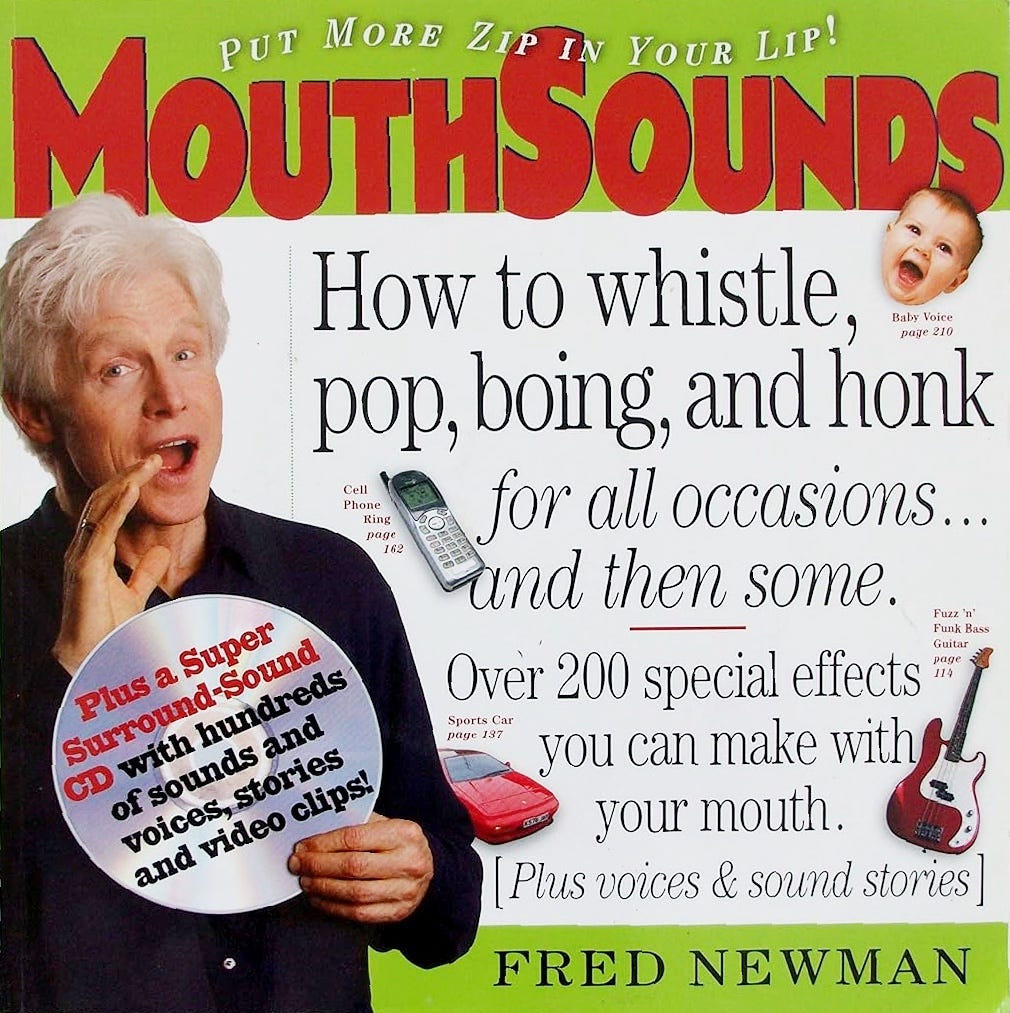
For practical help, we need to go to the world’s lovable weirdos. The famed sound-effect artist Fred Newman wrote a book, MouthSounds: How to Whistle, Pop, Boing, and Honk, For All Occasions (and Then Some)4. This is a good place for us to start, and an excellent target to aim for.
How might we start small, now?
Grab a nearby object — I’m picking up a coffee cup. How many distinct noises can you make on it? It can make…
a “ting ting ting” when I tap my fingernail on the handle
a “ding ding ding” when I tap my fingernail on the bowl
make a bell-like “ssssssss” when I lightly circle my fingertip across the lip
make a deep “whoof” like someone stomping on the roof when I clap my palm over the bowl
make a “bwap bwap bwap” when I clap my palm on the bottom
…and that’s just with my hand!
Grab another object, and list what sounds you can make it make in the comments below.
10. Related patterns
As hearing is a specialized form of touching (every sound is air touching your ear drums in a particular way), I suppose this is actually a special case of STRANGE SENSATIONS°. Other intensely SOMATIC (🤸♀️) patterns include KNOW A TREE° and KNOW A PLACE°.
This also lays the foundation for PLAYING INSTRUMENTS° — we skip too quickly to formal music instruments, which are truly just wonderfully-engineered noise-making objects!
Afterword
Maybe I erred by smooshing together “make noises with your body” and “make noises with Tupperware containers”! Among other things, it means that I didn’t emphasize Egan’s notion that we should help kids whistle, which I feel is an underappreciated art.
Forgive me for stating the obvious.
And if you don’t believe me, would you like to babysit my 18-month-old?
The Reggio Emilia people literally talk about “the hundred languages of childhood”. If blowing raspberries isn’t a language of childhood, then my goodness, I don’t think I know anything about childhood.
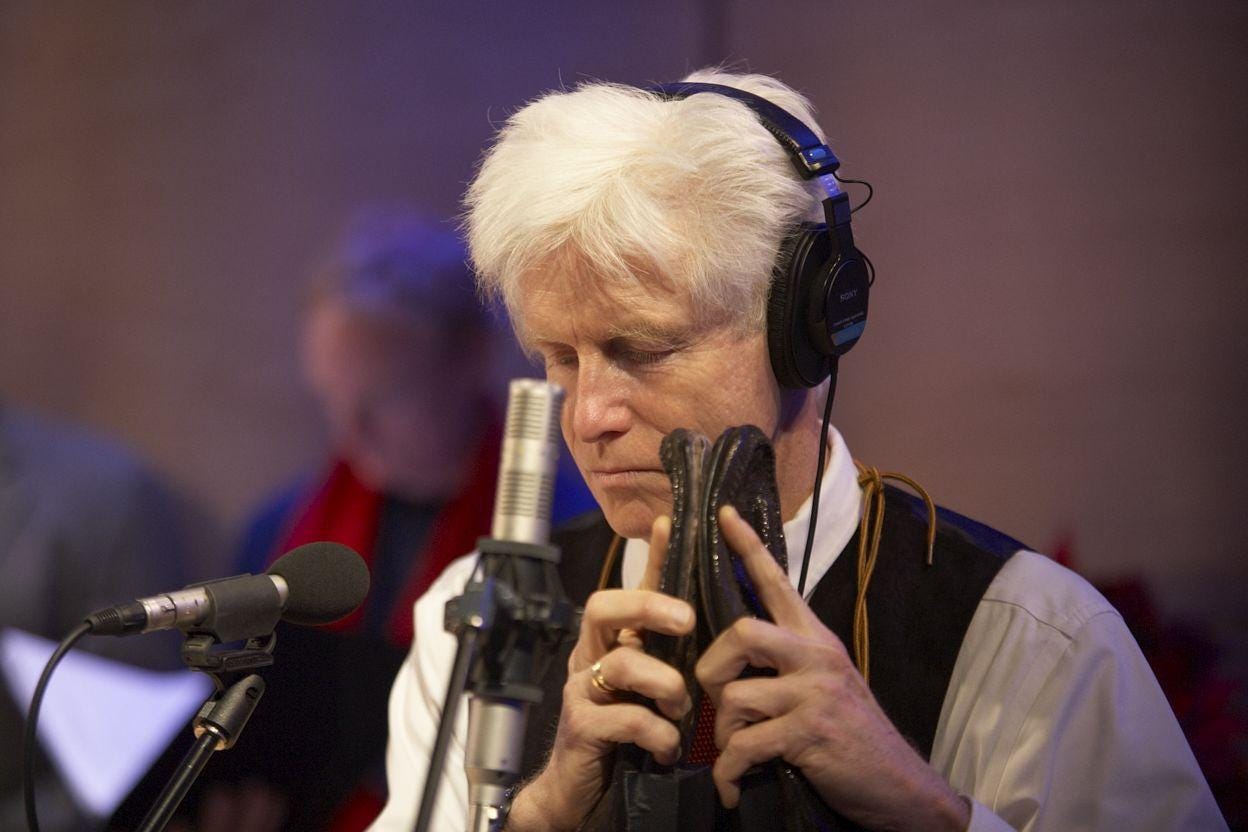
If you ever listened to the NPR show A Prairie Home Companion, you’ve already heard his whistling, popping, boinging, and honking.
The 100 languages of childhood reference is germane.
I would suggest that there's an interesting sub-partition between exploring the world of sounds humans can make, and careful observing of the sounds humans ARE making in the world. This might be some city-privilege, but one of the best running conversations I have with my 16yo is discussing what particular babies / infants making noise on the train are trying to express. As every parent knows, there is a clear observable distinction between the heavy, fast wails of "I am deeply overheated and need something to change" and joyful arrhythmic squeals and pops of "I have a mouth and it goes like THIS!"
The classic way the first idea (make materials make sounds) shows up in classroom science curricula is "make an instrument." A few years back, I built a small robot that could be steered by specific pitch ranges, so instead of just needing to make *a* sound, students were trying to craft an instrument that could consistently make *these* tones. That was enough of an elevation for this middle school activity to keep HS science students engaged for a week.
I'm a lifelong A Prairie Home Companion fan and I've had the good fortune to see them perform live a few times and Fred Newman was a highlight every time. He is incredible! Listening to the show on the radio I'd always assumed there was more than one sound effects person... nope, just one super talented guy!