

In our last blueprint post, I laid out how we’re planning to rehumanize the boring part of the elementary school math curriculum: daily lessons. Today, I want to limn out the obviously exciting part that we’re putting in: puzzles.
Elementary math thread 2: 🧵PUZZLES
It’s one of those niggling facts of history that the brilliant minds who created the discipline of math… had no standardized math curriculum to learn it from themselves.
It’s not that these people (and I’m talking about the Greeks1) were somehow more brilliant than their neighbors — the centuries before and after their Golden Age show they were average. As the historian of math Reviel Netz points out, they were lucky enough to live at a cultural moment where a few ingredients came together. One of those was that they were the heirs of the mathematics of the Babylonians:
The Babylonians were masters of numbers…. the training of Mesopotamian bureaucrats was always geared toward the needs of the state.
But what the state needs, above all, is legitimacy, meaning, symbolism. What ancient masters of knowledge were doing, above all, was looking for signs…. The world was a web of signs, point to each other and ultimately shining light… on the big questions of the state: the rivers, the kings, the outcome of war.
– Reviel Netz, Why the Ancient Greeks Matter: The Problematic Miracle that was Greece
The Babylonians taught by puzzles that would look familiar to anyone who’s taken algebra: “the area of a square and the length of its side, taken together, equals three-fourths: what is the length of the side?”. What changed, though, is the context in which the Greeks heard the puzzles. While, for the Babylonians, they had been sets of problems encountered in classrooms for nose-grinding scribes-in-training…
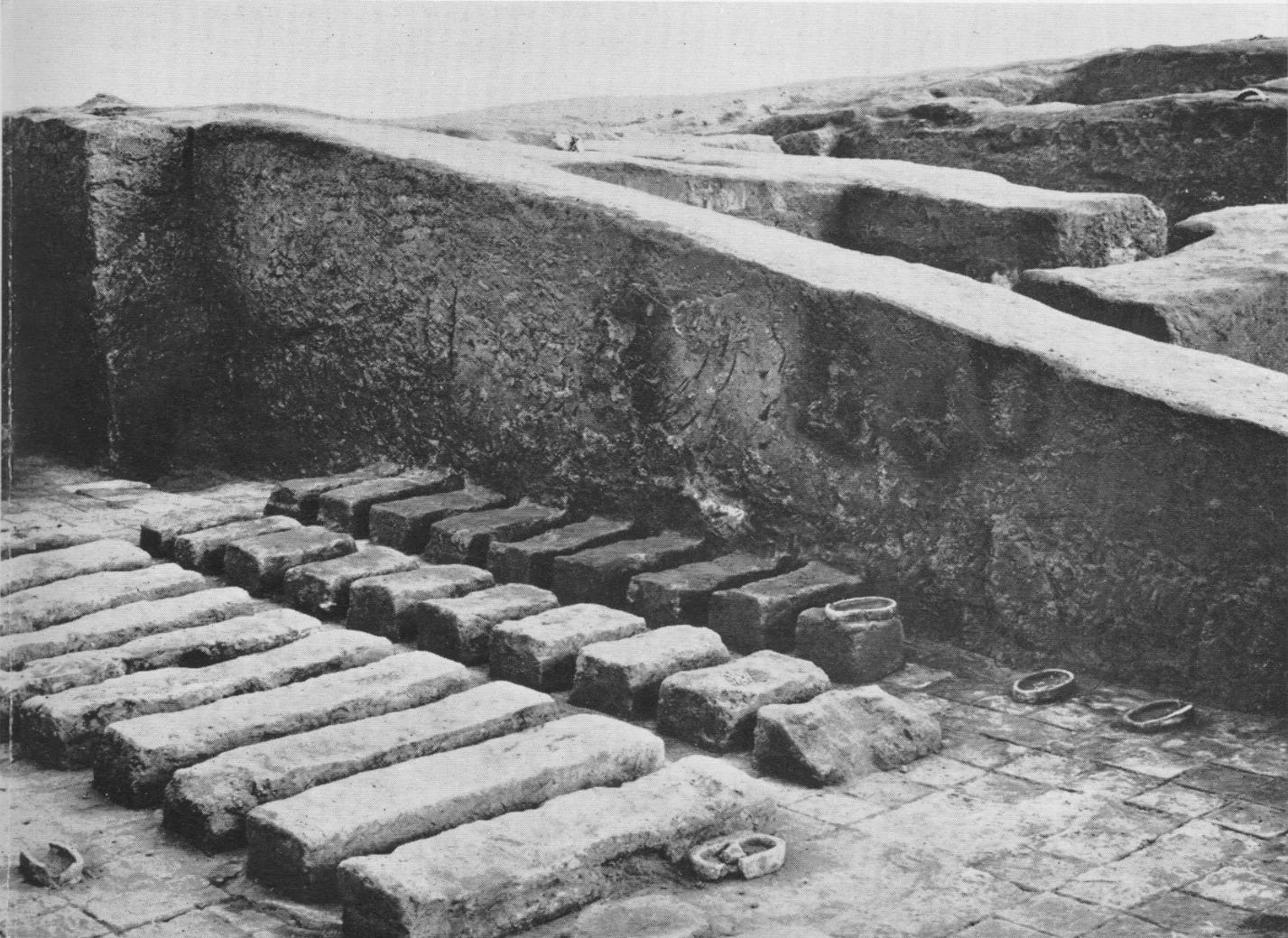
…for Greeks, these were presented as “nice puzzles”:
The school exercises were, among other things, nice puzzles. Maybe we need to imagine caravans with merchants from different lands, camped for the night, sharing tales and riddles. They did not know it but those mathematical riddles could well have been their most precious cargo. From such small events, knowledge gets transferred.
By encountering these problems as tasty treats in themselves, some Greeks began to savor mathematics.
This isn’t the only ingredient in the Greek invention of systematic mathematics. (We’ll explore another ingredient in our post on middle school math.) But it is an important one — so 🧵PUZZLES will be a second thread in our math curriculum, one that will extend the magic of math outside the mainstream curriculum.
🧵PUZZLES, Practice A: Mysterious Messages°
There’s something satisfying about cracking a code. Enciphered messages will appear in our classrooms, and we’ll drop hints as to how kids might be able to unravel the 🧙♂️MYSTERIES.
They’ll start simply (e.g. A = 1, B = 2…) and very, very slowly become harder. Eventually, they’ll lead kids into thinking about their native language (e.g. English) from a mathematical perspective — what letters are most common? Which two-and-three-letter combinations are most common?
For more on this, see my previous post Mysterious Messages°.
🧵PUZZLES, Practice B: Board Games°
Turn-based 🧙♂️GAMES are already ripe with analytical thinking. And while there are some overtly mathematical games that are actually enjoyable to play — Prime Climb is probably everyone’s favorite here — in truth, any game that features strategy is inherently math in disguise.
Think Connect Four or Carcassonne. Think Hive or Risk. Heck, think Tic Tac Toe — they all reward seeing (and exploiting) patterns. In middle school, we’ll talk about how to make them more deeply mathematical while also making them more fun. But for that to work, the kids first need to enjoy the games, so we’ll start this early.
🧵PUZZLES, Practice C: Jokes°
A 🧙♂️JOKE is perhaps the most immediately-rewarding type of reasoning. Each is a tiny house of screwy logic;2 “getting” the punchline requires making a new sense of how the pieces fit together.
I.I.: It feels faintly ridiculous to put this into the “math” curriculum, though.
Which means there’s a lot of low-hanging fruit here! We want to have kids read jokes, practice telling them, and even make their own. In elementary school, our focus will be on wordplay — puns, knock-knock jokes, lightbulb jokes, and so on.
I.I.: I’m not sure I could take a whole classroom of joke-spouting children.
Indeed, it’s hard to be a teacher. But the payoff is worth it; as Egan writes:
Stimulating each child to become a jokester is fundamental to the later development of logical thinking.
– Kieran Egan, Primary Understanding
And we want kids who are logical — and who know how to bend logic. For more on this, check out my earlier post, Telling Jokes°.
🧵PUZZLES, Practice D: Strange Math°
There are so many branches of mathematics that never darken the doorway of an elementary school. Some barely enter into K–12 education at all — think topology, game theory, and so on. Each branch of math has its classic riddles, stories, and games.
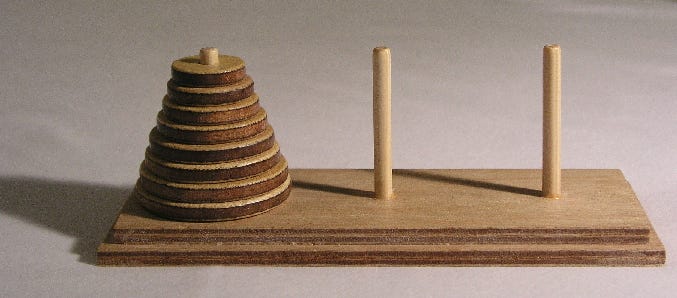
Among math geeks many of these are famous, and you probably already know of some of them already — the Tower of Hanoi, the grains of rice on a chessboard, Zeno’s paradoxes, a young Carl Friedrich Gauss adding all the numbers from 1 to 100 in his head, and so on. These survive because they’re fun!
Our goal is to collect perhaps a hundred of these, and to bring them into the classroom once a week. We’ll be engaging them in a manner inspired by the people who champion “Thinking Classrooms”, and then perhaps find ways to turn up the drama by triggering 🧙♂️EMOTIONAL BINARIES and ramping up the 🧙♂️FANTASY.
And a good way to do that, of course, is to narrativize the puzzle. Let’s take the Tower of Hanoi as an example.
Phase 1: 💥 Orient
Our first step, as always, is to help kids feel something. The Tower of Hanoi started as a silly story told by a 19th century mathematician. We can modify his version a little as we tell it:
In a land far, far away, there is a tower. On the top of this tower are three diamond needles. And on the first needle, when the world was young, priests stacked 64 disks of pure gold, each one slightly smaller than the one beneath it, forming a perfect cone.
The priests were charged with a sacred duty: move the entire stack of golden disks to the third needle. They only had to follow two rules:
they could only move one disk at a time, and
they could never place a larger disk on top of a smaller one.
When they complete their duty, the world will come to an end.
How long will that take?
Phase 2: ⚠️ Complicate
Now it’s time for the kids to get hands-on. Give them a little version of the tower (you can make one, or buy one for $10), and challenge them to move any size of stack (four is fine; three or even two is fine to begin) from one needle to the other following the rules. Then, of course, have them add more disks. How many can they manage?
Phase 3: 🐛 Transform
Here, we want them to produce something that shows their understanding of the specific pattern for solving a certain number of disks, or (better) the general pattern for solving any number of disks.
I.I.: And what should they produce?
For this, they could, say, write a letter, teach it to a friend, draw a diagram, or shoot an explainer for YouTube. (Across their education, elementary schoolers should be experimenting with many types of production, so just make sure they’re getting a smattering of everything.)
Phase 4: 🪢 Integrate
As usual, it’s good to “close the book” on this, and prompt the kids to reflect on what they did — what they discovered, what surprised them, what they learned about themselves, whatever. This needn’t take more than a couple minutes.
And then the puzzle can be put away for a few years… until we return to it in middle school.
Imaginary Interlocutor: Where would I get a collection of math problems like this?
Start with this post:

It’s written by the invariably insightful and preternaturally pleasant Dylan Kane, who was generous in spending a couple hours talking through this practice with me. I suddenly realize that I’ve somehow never formally recommended his Substack. Fixed!
Next up: A quixotic goal
If we do our job well (and the stars are aligned), the four practices above will help most kids fall in love with math. This is, obviously, a ridiculous goal to swing for — but then, why else get out of bed in the morning? In any case, any sensible person would say that, having achieved it, we should move onto other topics. (Geography! Writing! Cooking!)
We, however, suspect that there could be one more remarkable thing to pursue in elementary school math: stupendous feats of mental math. Look for it in our next post.
(Inspiration for this post came from Dan & Katherine Cook at Math for Love, who introduced me to the Julia Robinson Math Festivals. All I can say is, if someone ever asks you to spend three hours in a gymnasium pushing artfully weird math puzzles at middle schoolers, say yes.)
© 2026 losttools.org. CC BY 4.0
If you’re furtively worrying whether it’s maybe a little racist to say that, the book I’ll be citing below is written as a direct answer to that question. And it’s well-written! Recommended.
Ooh, that’s a good line. Title text, here we come!
This was my favorite math joke as a kid.
Proof that a cat has three tails:
- No cat has two tails.
- One cat has one more tail than no cat.
- Therefore, one cat has three tails.
The Glimpses list is great! A few other math-y puzzle-y things we love:
- which one doesn't belong https://talkingmathwithkids.com/wodb/ (the fun twist is that all of them don't belong, for different reasons)
- Catriona Agg's geometry puzzles at https://drive.google.com/file/d/1hVP8tLURVDphmHsphz5BQLVzHCeTts29/view
- Zome Tools and the accompanying geometry text. The nerdiest building toy, with lots of questions like "how many different kinds of regular skew polygons can you build?"
- Smart Games single player logic games. Lots of different mechanics, themes, and difficulty levels, some more portable than others.
- Turing Tumble (and Spintronics and Bridge or Bust but those are less overtly math-y)
- Oops All Fractions. If you've played All Ten much, you know that often it's really easy but occasionally you can only get one of the numbers by using fractions in a tricky way. The kids usually are faster than we are at All Ten these days, except for those cases. Enter Oops All Fractions. https://benhayden.us/oopsallfractions. Click on an equation 5 times for a hint.
The 8 year old has been game schooling me for years. SET and Proof are favorite math-y card games, Project L and Blokus are favorite polyomino games, Abduction is adorable and has great spatial reasoning, and Zendo is a fantastic inductive reasoning game. You can play a simplified game with household objects; the idea is just to create a build that follows a mystery rule and a build that doesn't, the other players then make their own builds and are told whether or not they follow the rule and when they are ready they try to guess the rule. Surprisingly challenging. Canvas is a strategy game that I think is great for a bunch of reasons: there's the typical optimization with competing goals element, but also the creativity of layering translucent cards to make paintings and the wordplay of the names that result from layering them. And at the start of the game you select 4 goal cards for the game, which provides kids with a way of shaping the game play experience without destroying it. Anti-chess is another favorite lately. Chess, but if you are able to make a capture you have to and your goal is to get all your pieces captured before you're forced to capture all your opponents pieces. Unfortunately for me being bad at chess doesn't make one good at anti-chess.
I honestly don't think getting kids to fall in love with math has to be that hard. I think one of the main challenges is that our culture normalizes adults modeling math refusal (the frequency of the question "how do I get my kid to do algebra given that I will obviously not be willing to engage with algebra in any way" in homeschooling groups is heartbreaking). Puzzles are a great way to let kids see adults being willing to engage with tough math, be stumped, and even be outsmarted by kids. How could they not love that?