

“The universe… is written in the language of mathematics.”
– Galileo Galilei
Since this was written in 1623, the life of the mind hasn’t been the same.
Before Galileo, there were two streams of mathematics. The first saw numbers as mystical objects with hidden meanings — the “magic” of numbers that we wrote of last week. The second saw numbers as a means to the end of measuring stuff. Galileo fused these streams. He realized that math can subdue reality not because (per the Greeks) whole numbers were special, but because the universe is spun not out of words or stories but out of ratios.
We want middle schoolers to feel this shift. While in elementary school we helped kids fall in love with numbers for their own sake, now we want to invite them into the project of using numbers to wrestle the blooming, buzzing confusion of the world into neat models that let us understand it.
Imaginary Interlocutor: This sounds… romantic, and not entirely practical.
It’s a high goal, to be sure. To meet it, we need to plug into the energies unleashed by ROMANTIC (🦹♂️) understanding as kids grow up. Hank Green — who understands more-or-less everything! — understands adolescence, too:
There’s something in all of us, something that blooms in adolescence and never leaves… and it’s just… want. And the most amazing tool that anyone in the world can have is the ability to control and direct that want.
This “want” can take many forms — fame, excellence, a longing to matter. Any attempt to rehumanize education has to provide ways to channel this.
Just as in elementary school, our middle school math curriculum will follow three threads:
🧵 LESSONS, where we push against our own limits,
🧵 PUZZLES, where we complicate the extra-curricular math we saw before and discover a hidden simplicity, and
🧵 QUIXOTIC GOALS, where we use all of this to do something crazy: Fermi estimates and Bayesian reasoning.
Middle school math thread 1: 🧵DAILY LESSONS
In which we get to feel our boundaries, and poke through them
🧵LESSONS, Practice A: Daily Ladders°
As in elementary school, so in middle school we’ll ground ourselves in a pre-existing math curriculum. I introduced JUMP Math last week; it’ll continue apace.
🧵LESSONS, Practice B: Boss Problems°
These, too, continue more or less the same, though of course with higher levels of math. If anything, you can make these bigger and brasher to fit the mood of self-overcoming. (See our explanation of Boss Problems° in elementary school for more.)
🧵LESSONS, Practice C: Number Extremes°
Here, we’ve got some bigger changes. In elementary school, we spent some time Making Friends with Numbers°. In middle school, we keep this going — but our numbers increasingly get wilder.
It turns out that the world is big. To describe it with numbers, we’re gonna need some very big numbers. At first glance, this is no problem at all — numbers increase endlessly. But practically, we have no innate ways to differentiate big numbers from one another. To most adults, “a quadrillion” and “a quintillion” sound more-or-less the same, even though one is a thousand times bigger. (And you’ll remember if I say “sexillion” only because it makes you snicker.)
The difficulty of understanding big numbers has famously led to some very bad decisions:
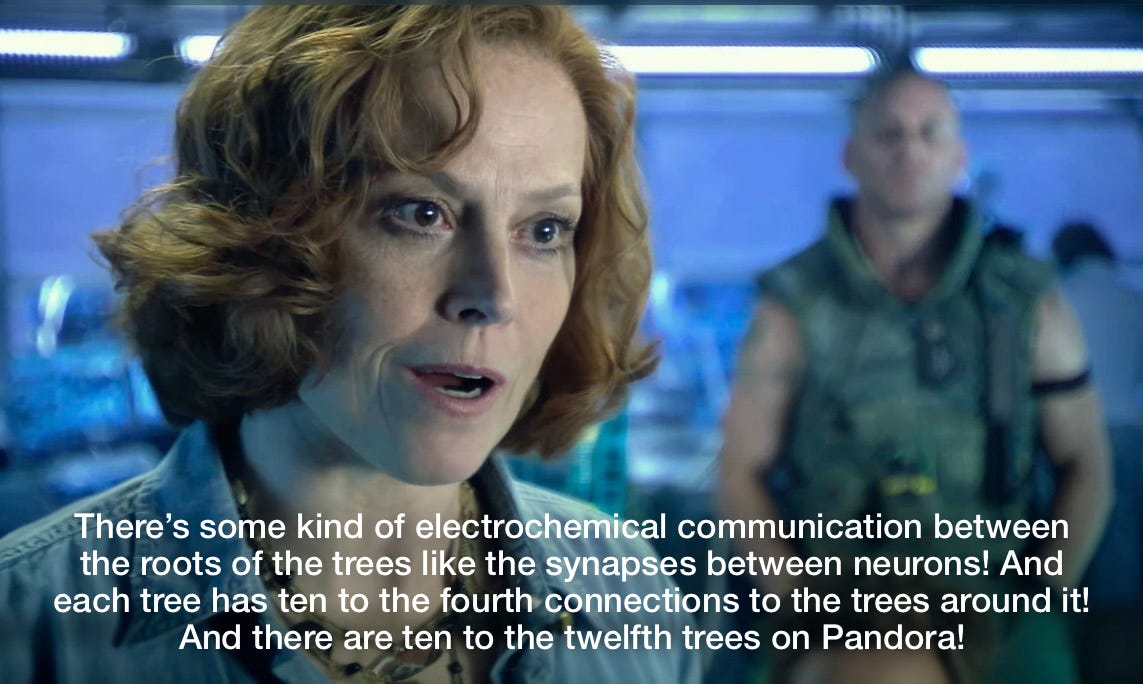
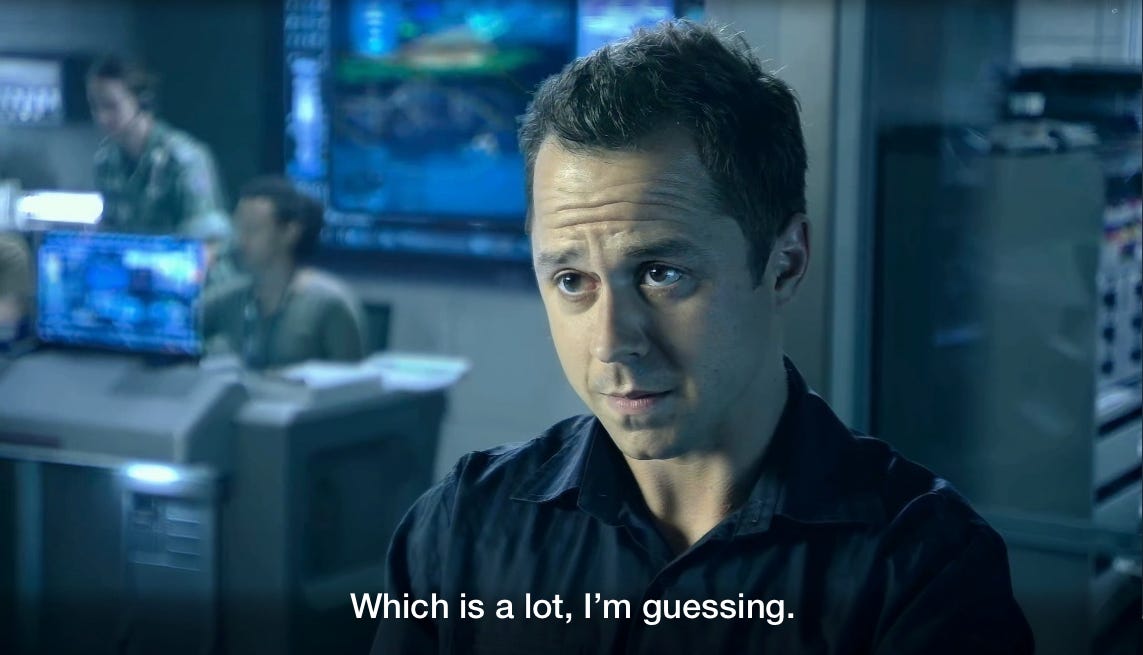
One immediate goal is to create a vivid mental image for the “illions” — when you think of a million, you could think of (to pick just one thing that I learned watching Reading Rainbow) the number of goldfish bowls it would take to hold a whale. A cube of a billion Go Pro’s would crush a Target store.
I.I.: Oh yeah, I think one of my teachers did this with our class, once.
Indeed, picturing large numbers isn’t unknown in school. (Here’s a particularly excellent example.) What’s missing, we think, is treating it as an essential part of the curriculum. Time should be devoted to coming up with a 🧙♂️VIVID MENTAL IMAGE of each “illion”, and then they should be remembered and used throughout the rest of math, and the other subjects, too.
I.I.: What about big numbers that are less than, like, a million?
It’d be nice to have mental images for other “big” numbers —
hundreds (100, 200, 300…)
thousands (1,000;1 2,000; 3,000…)
ten thousands (10,000; 20,000; 30,000…)
hundred thousands (you get the idea)
If you’d like to help out, throw some in the comments below! My recommendation is just that these all be (1) countable objects rather than measurements, and (2) vividly memorable.
I.I.: What about numbers that are much higher than the “illions”? Are those really necessary?
Practical usefulness is only one goal in learning these numbers: the other part is the sheer mind-boggle that comes from contemplating such 🦹♂️EXTREMES in quantity.
How big is a googol, really? How can we feel it? How about a googolplex? And did you know that there are named, meaningful numbers that make a googol look like taking a whizz in the ocean?2
I.I.: Hasn’t this already been covered in your post Masters of Measurementº?
Masters of Measurement° works with units — meters, kilometers, megameters, gigaliters, and so forth. This practice is just about countable numbers, which is a prerequisite for understanding those. (You can’t really understand what a “teraliter” is without feeling how big a “trillion” is.) Look for both of these to become part of the first of middle school’s 🧵QUIXOTIC GOALS, Fermi Estimates.
I.I.: How can I do this, now?
Simply extend the notebook (or cards) you made to Make Friends with Numbers° in elementary school to include these extreme numbers.
🧵LESSONS, Practice D: Origin Stories of Math°
In elementary school, we made sure to tell the 🧙♂️SIMPLE STORIES behind the symbols of math. A challenge was that many of the details have been lost. (Am I the only one who’s bothered by the fact that we don’t really know where the ÷ symbol comes from?)
In middle school, of course, the math that students learn becomes more complex — functions, rates, rational numbers, and so forth. The silver lining here is that these tend to have been developed more recently, often by specific people whose stories we know.
Historically, these people are often odd. The Pythagoreans worshipped integers, refused to eat beans, and murdered one of their members when he discovered irrational numbers. René Descartes believed he discovered the seat of the soul, did most of his work in bed, and invented his “Cartesian coordinate system” while watching a fly wander the ceiling. The decimal number system was introduced to Europe by a pope who built a hydraulic organ along with — according to rumor — a mechanical head which would answer any question he asked it.3
Again, these people are odd. Our job, pedagogically, is to make them into 🦹♂️HEROES who wrested fire from the gods.
I.I.: But how true should we make these stories? (I note that the thing about Pythagoreans murdering the guy who discovered irrationals is a legend told centuries afterwards.)
In general, of course, we should strive to be truthful. In our history classes, that’s especially important. But we can’t forget that one of the reasons for these origin stories is to induct kids into the 🦹♂️LORE of math. A safe compromise would be to be quick to include the mythical stories, but to name them as such. (The book The Cult of Pythagoras: Math and Myths is, sigh, a particularly solid debunker of some of my favorite stories.)
I.I.: Can we really spend the time in math to tell stories?
I have two answers to this; one is happy, the other is angry. First, the happy answer: because we’ve made a memory palace in elementary school history, we’re able to tell a memorable math story in just a few sentences. That is, we’ve already helped kids understand what life was like at many different locations & times; now, all it takes to set a math story in ancient Greece is to say, “the Pythagoreans lived in ancient Greece”.
Now, the other answer. I don’t know how to say this clearly enough:
With apologies to Steve Jobs, learning can be so much broader once we discover one simple fact: that everything we call “math” was made up by people who were no smarter than us. Well, okay, a good number of them were geniuses — but none of the formulas or algorithms that students struggle to learn was obvious to the person who first figured it out. It was an achievement. It felt like stealing fire from the gods. To master it while knowing its origin is to teleport through time back into their skin, and to become a hero, if only for a moment.
This is part of what we mean when we talk about “re-humanizing math”.
🧵LESSONS, Practice E: The Deep Practice Book°
In elementary school, we introduced the practice The Return of the Bosses° — on Fridays, pull out the Boss Problems° that bedeviled you, and take another pass at them. This was mostly intended to solve the problem of memory by bringing some light spaced repetition into the math curriculum.
In middle school, we’re going to deepen this with a “Deep Practice Book” (hereafter “DPB”). I wrote quite a lot about this in one of my favorite posts:

In a nutshell, it’s a notebook built on deliberate practice.
I.I.: Wait, in that post, didn’t you say that a DPB was “doomed to fall into a pit and crash and burn when it enters the classroom”?
Yes, because it’s built on deliberate practice. Deliberate practice sucks. It’s hard and boring and painful. It demands repetition and attention, the willingness to veer into error and correct it again and again with the stubbornness of a saint. It’s singularly unglamorous. Everyone hates it. Throughout the history of education, every single attempt to force deliberate attention on an unwilling subject has backfired.
I.I.: Why are we talking about this, then?
Because it is the one best way to grow skill. But in order for it to work, you need to want to grow skill.
I.I.: And how are we cultivating a “want” for math?
In short, everything I wrote in the last three posts, on elementary school math. But we can summarize those in two pieces:
practices that help you fall in love with the math itself, and
practices that help you develop a taste for getting stumped by hard problems.
In adolescence, all this can be multiplied by the joy of 🦹♂️SELF-OVERCOMING… something that teenagers often have in spades. (This is why we didn’t introduce DPBs in elementary school — and for many students, the DPB should be held back until high school.)
Here’s a reminder of what it can look like:
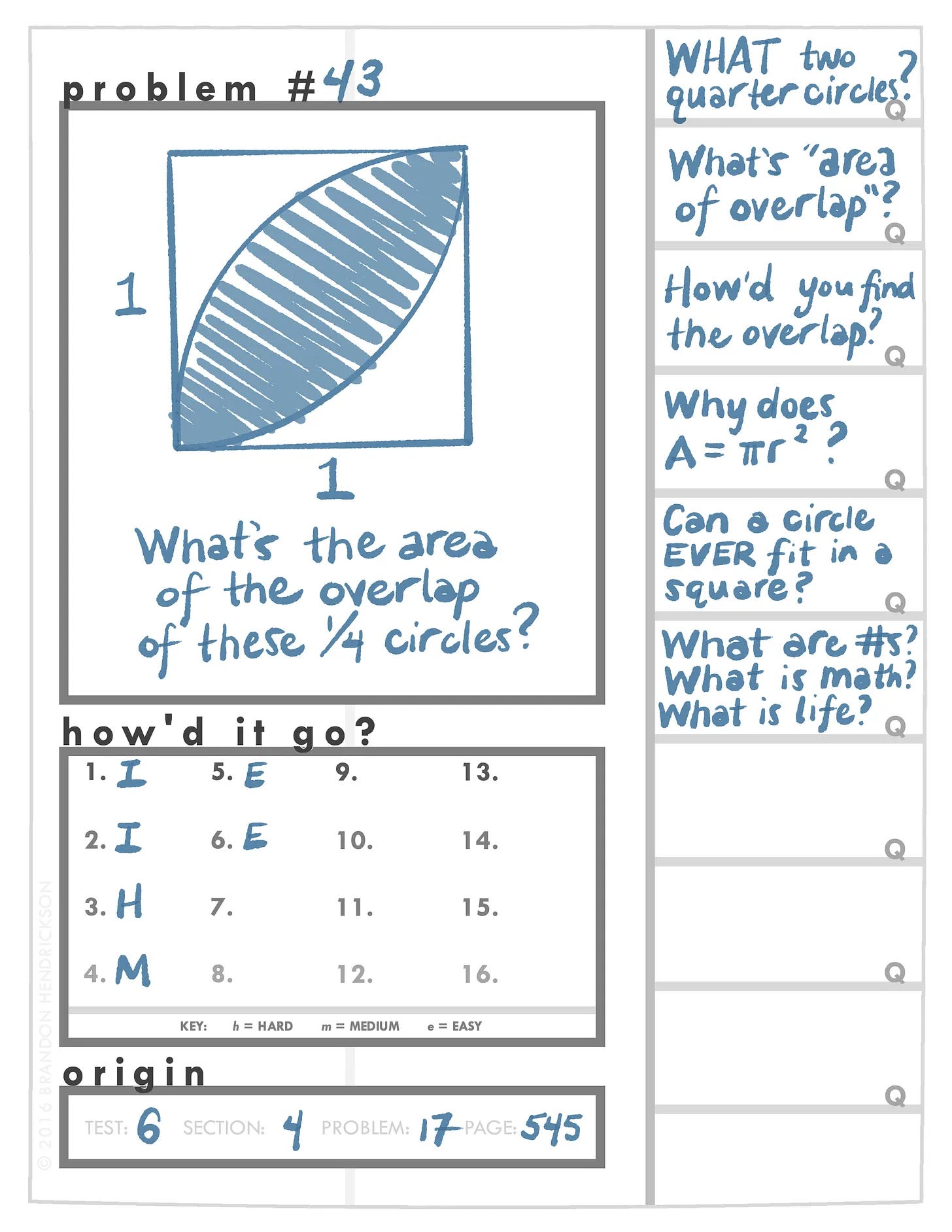
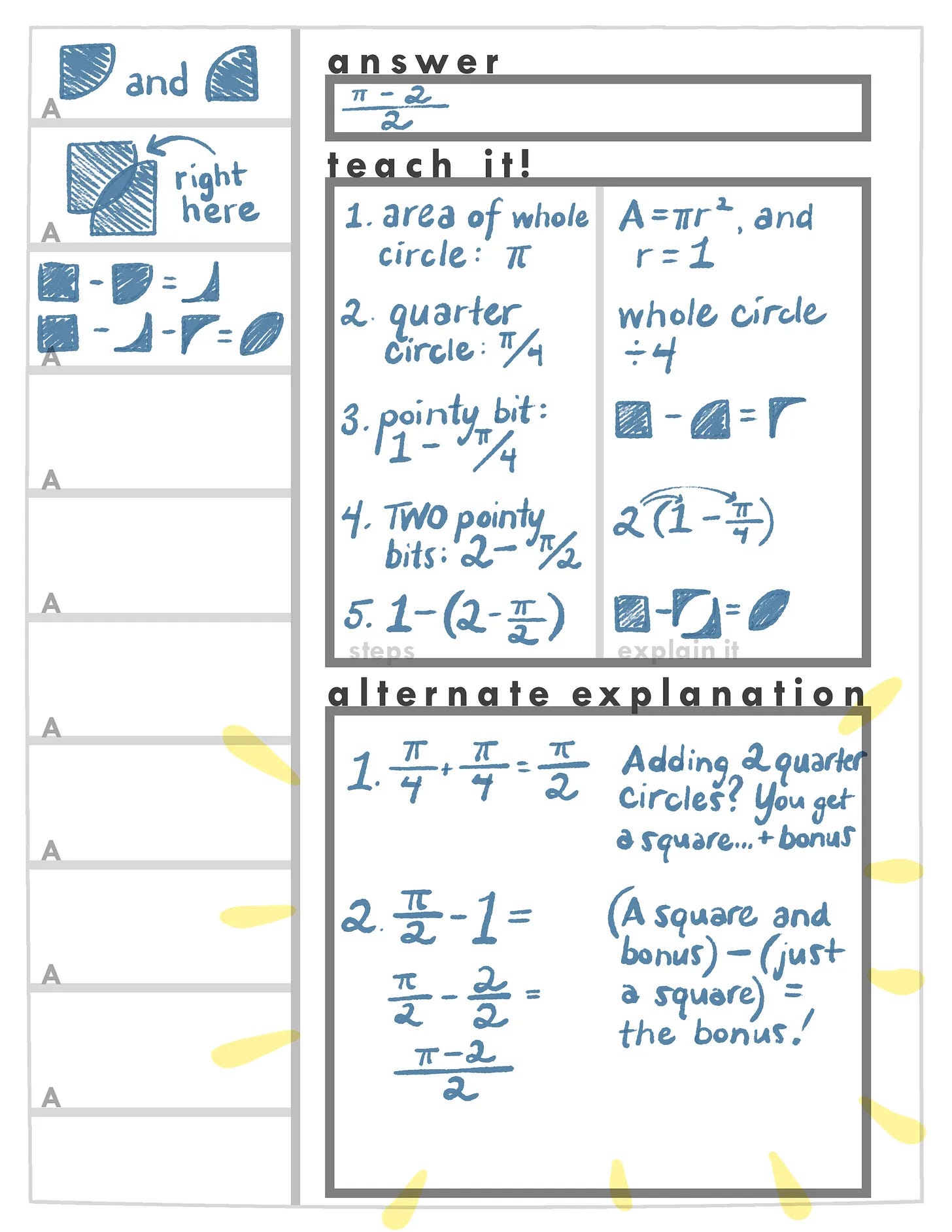
If you’re interested, go ahead and re-read that essay. To capitalize on 🦹♂️SELF-OVERCOMING in the middle-school years, you might want to focus on the “How’d it go?” section on the front page, in which students record how difficult the problem was for them:
I = impossible
H = hard
M = medium
E = easy
A = automatic
All in all, a DPB can become a mathematical dojo — a place to go, be knocked onto your back, and get up stronger (and hopefully wiser).
Next up: Puzzles in middle school math
Hopefully, you’re getting a glimpse of the personal transformations that we’re trying to make happen through math. I wrote last week about how the “magic” of math can only really be brought out when we take math seriously — and help kids take it seriously, too. People pushed back on that! Alessandro and I will be recording a conversation soon with the redoubtable Michelle Scharfe, creator of Minimalist Math (and of researchparent.com) who thinks all my talk about “seriousness” is me trying to look edgy and cool towards traditionalists. Maybe she’s right!
In any case, I think that in middle school, the payoff of “seriousness” is greater. There’s a desire in teens to transcend boundaries and embody 🦹♂️HEROISM. But as any Marvel character can tell you, being a hero sucks.
Do you want to be a hero?
Look forward to seeing how this can be done with less pain and more joy in our next thread: 🧵PUZZLES.
© 2026 losttools.org. CC BY 4.0
Did you know that the world record for “most legs” is held by a millipede that actually has a thousand legs?
And here I’d be a fool to not recommend the wonderful episode “(Finite) Numbers So Large They’d Destroy You” from the podcast “The Rest Is Science”, co-hosted by mathematician Hannah Fry and the justifiably famous YouTuber Vsauce.
Also he’s said to have gained the papacy with the help of a succubus named Meridiana, but, um, we don’t need to tell kids ALL the cool math stories right away.
If you haven't read David Bressoud's _A Radical Approach to Real Analysis_, you might find it interesting: it's a classic use of origin stories at a very different level of mathematical pedagogy. It probably did more than any other book to make me a mathematician (probably aided by the fact that I took the relevant course from Prof. Bressoud himself), and even though I'm not a mathematician anymore, I'm grateful to have been one.
I still think that Anki, thoughtfully integrated, can make math spaced repetition less onerous. There are a ton of "math facts" that go beyond times tables and can easily flummox a person; even if you sort of know them a lack of fluency may impact ability to use processing power on the part of the problem that demands it. Just a few (from pre-alg/alg I) off the top of my head that tend to not get enough natural practice via math's inherent spiral-y-ness: zero and negative exponents, logarithm notation, imaginary numbers, simplifying radicals, expressing radicals as exponents, and words like domain, range, monic, and binomial.
If we make math learning more efficient, people can either spend very little time on math or move through the sequence more quickly. We're going for more quickly here, because we'd like to be able to help them unlock as much of the world of math as we can without turning their teenage years into a horrifically stressful rush through algebra, geometry, trig and calculus. But of course that plan can't work unless they maintain a pretty significant amount of math knowledge over many years. I think that even for older kids it might be hard to maintain a paper system for spaced repetition of such a large quantity of math, though I can imagine it being an absolutely wonderful system for preparing for a test with a relatively narrowly defined scope like the SAT.