


There’s been some excitement online recently about teaching kids to become philosophers.
This is something I think about a lot. I’ve taught philosophy classes, but I also have a habit of turning whatever I’m doing with kids — math, vocabulary, recess1 — into a philosophy seminar. Science is WEIRD occasionally gets criticized for being “too philosophical”.
This is all what you might expect from someone who used to run a program called “Young Philosophers” out of his Seattle-area apartment.
Lately, though, I’ve been getting excited about a new way that kids can have a profound interaction with philosophy… at an earlier age than ever before.
Imaginary Interlocutor: Philosophy is self-pleasuring for eggheads. Why would anyone want to waste kids time with this?
Oh my gosh you’re so wrong! Philosophy done well can make kids morally curious, serious, and intellectually bold (but epistemologically humble). Don’t think of philosophy as a set of content to be learned (though it is some of that), but rather as a disciplined way to engage the world through abstractions.
I.I.: That’s a lot to claim.
Agreed, but because this is a quick little side post, this isn’t the spot to lay out here the big picture of why philosophy is close to the beating heart of education. Feel free to skim through my earlier pattern Philosophy Everywhere°, or wait until Alessandro and I publish our “Philosophy Wireframe” near the end of the year. But since I know some of you would like to take advantage of these while your kids are still young, I thought I’d write down some of these early-age practices now.
But before I give them, I need to nod — bow? — toward Philosophy for Children.
Philosophy for Children (often abbreviated P4C) was founded in the 1970s by Matthew Lipman. Its claim is ambitious: children are capable of genuine philosophical thought far earlier than we usually assume. The basic method (let’s call it “OG P4C”) looks a lot like a seminar: kids sit in a circle, a teacher reads an age-appropriate story, and then the class raises big questions that come out of the story — questions about truth, fairness, identity, meaning, and so on.
I.I.: Okay, that actually sounds impressive.
When it works, it really is! The trouble is that too often, it doesn’t work. Sometimes it fails gracefully (chit-chat about zombies, in my experience); sometimes it fails ungracefully (“good” kids aping what they think the adult wants, and the rest concluding that philosophy is bunk).
I’m obviously not the first person to make these critiques. The P4C community is a haven of smart, idealistic people who don’t shirk from the need to be self-critical. And some of the newer techniques that they’ve come up with help make philosophical conversations easier to do with kids. Alessandro and I think we can go even further.
A lot of P4C still ports in the model of a college seminar, and assumes traits that not all kids have. But these traits can be cultivated. Using Egan’s methods, we can teach these skills directly, and help practice them as habits.
And in fact, one group has been doing exactly this for years — the Philosophy with Children movement. Founded by Carlo Maria Cirino, it’s now (miracle of miracles!) headed by one Alessandro Gelmi… who’s been sharing these practices with me.
Taking words seriously
All of these practices center on taking words seriously. As Ludwig Wittgenstein put it:
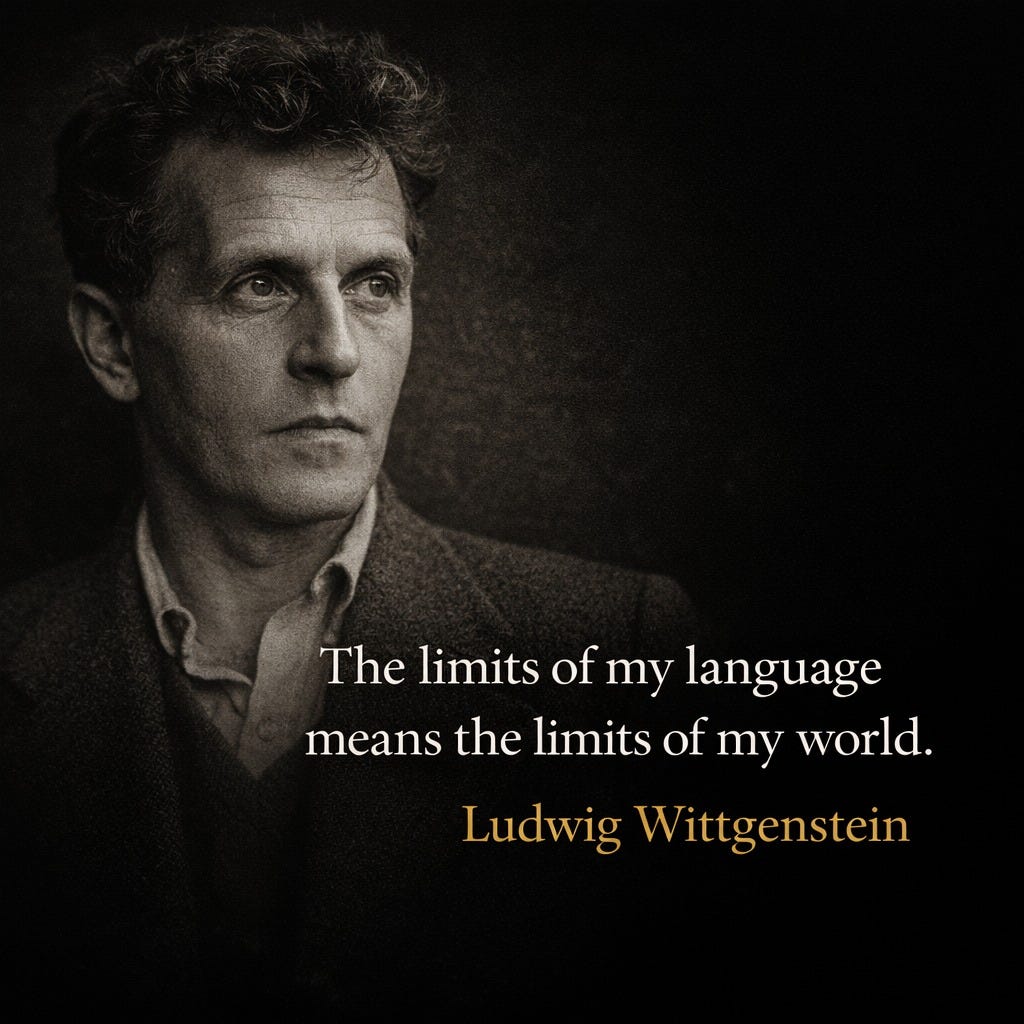
Philosophers use language in very interesting ways; this is, in fact, one of their powers. They ask what a word really means, and define terms precisely. They treat words as important, because they think they’re the best bricks we have in building a model of the world inside our heads. Words, used carefully, can get us to truths we couldn’t have grasped with our bodies.
P4C requires that kids…
have a wide working vocabulary
can listen attentively to the specific words someone else is saying
can notice what a particular word is doing in a sentence
While some kids — call them “philosophy Ravenclaws” — show an early bent toward these traits, no kid is born with this stuff. How can we help nearly all kids love to take words seriously?
The same as we do anything: use the tools. In this case, simple 🧙♂️GAMES that can be played with kids as young as three. If we succeed at this, then our kids will be hungry for the “real philosophy” that begins in the early grades (where we’ll be using P4C).
So — what are these games? Alessandro has shared three of them with me…
