


Last week I posted the outline of what might be the single most ambitious part of our epic twelve-year curriculum — elementary history — and the reaction to it might be described as “crickets chirping, unbothered by the chaos of the world.” And I think I know why. Outside of the few of us who have a bachelor’s degree in history, actually putting this into practice probably feels impossible (or worse).

So in this quick bonus post, I want to share a way I designed to make it trivially easy. Well, two ways.
🧵Thread 1: History memory palace
How can you pick a hundred stories? (Use AI!)
In the last post, I wrote:
After setting up your memory palace, pick ~100 great, true stories from history, read them to your kids, and play inside them.
But which ~100 stories should you pick?
Imaginary Interlocutor: Indeed! How could anyone have the expertise to pick these?
“What is most important” is the fundamental value question. We’re working on an answer we consider judicious and incisive (but is still guaranteed to be attacked by everyone).
But you can get an AI to do a passable job for you! Honestly, I’m surprised at how well the following prompt works for picking stories:
Help me build a “history memory palace” as described at https://www.losttools.org/p/history-in-elementary-school. Right now, give me three options for each of the “spots” in space 6. Make sure the events really happened in the times listed. Skew towards events that have visceral stories of individual humans at the center, the emotional binary of which can be easily grasped by a first-grader.This’ll give you three options for each; you can ask for more. Then just repeat, repeat, repeat for the other spaces.
I.I.: Dammit, Brandon, I’m a doctor, not a historian! This is still too much power for me to wield. How can you help me?
Last summer I spent ~5 hours populating a list of stories that people could choose from. It’s an imperfect list — our (secret) team is (secretly) working on building a better one. For each spot, it suggests three different stories:
a “classic” story (typically the most well-known of the bunch)
an “outsider’s” story (typically one centering someone whom traditional histories might have missed)
a story of invention & discovery
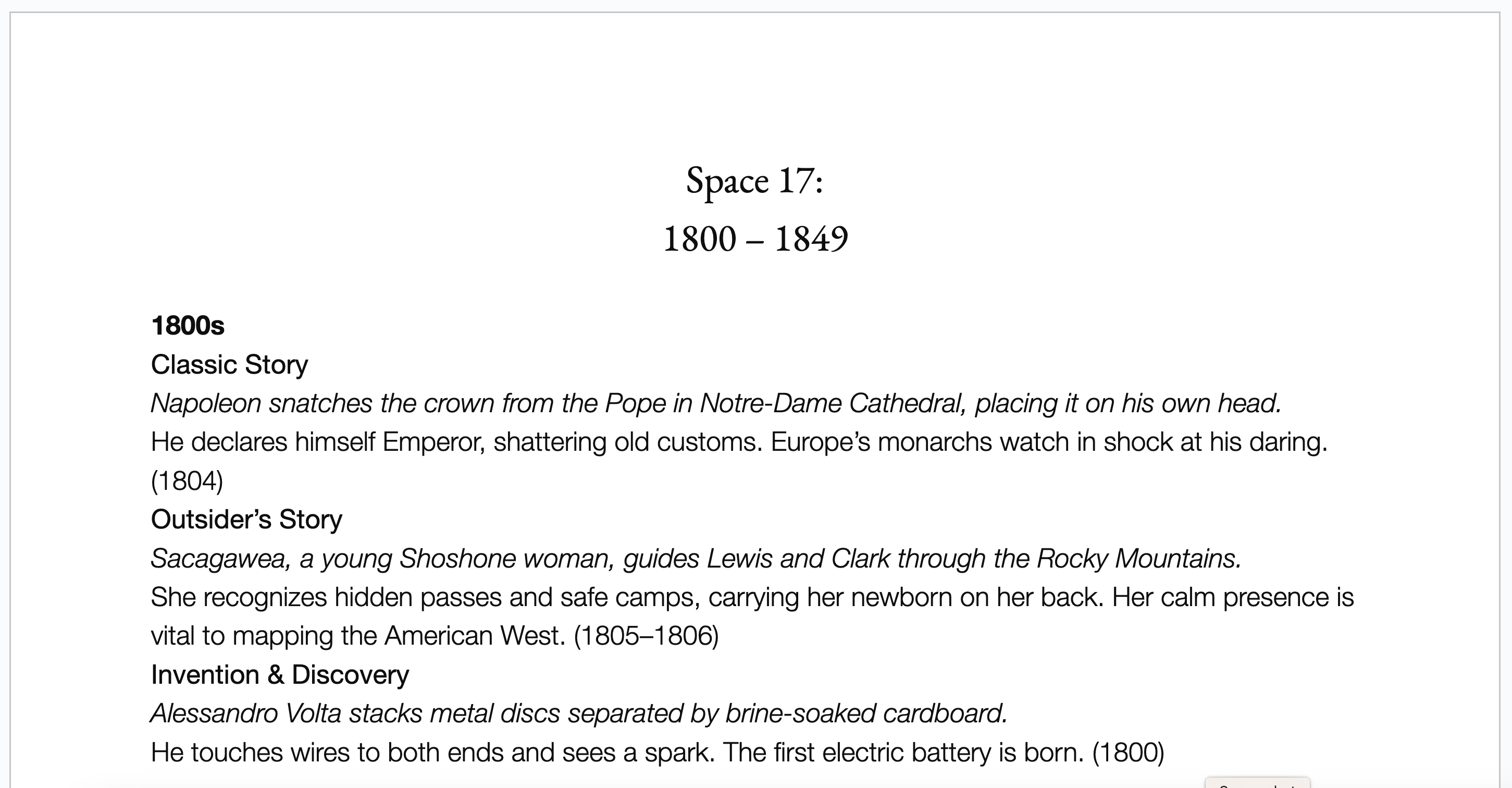
The document is nearly 40 pages long. Here’s a sample from modern history:
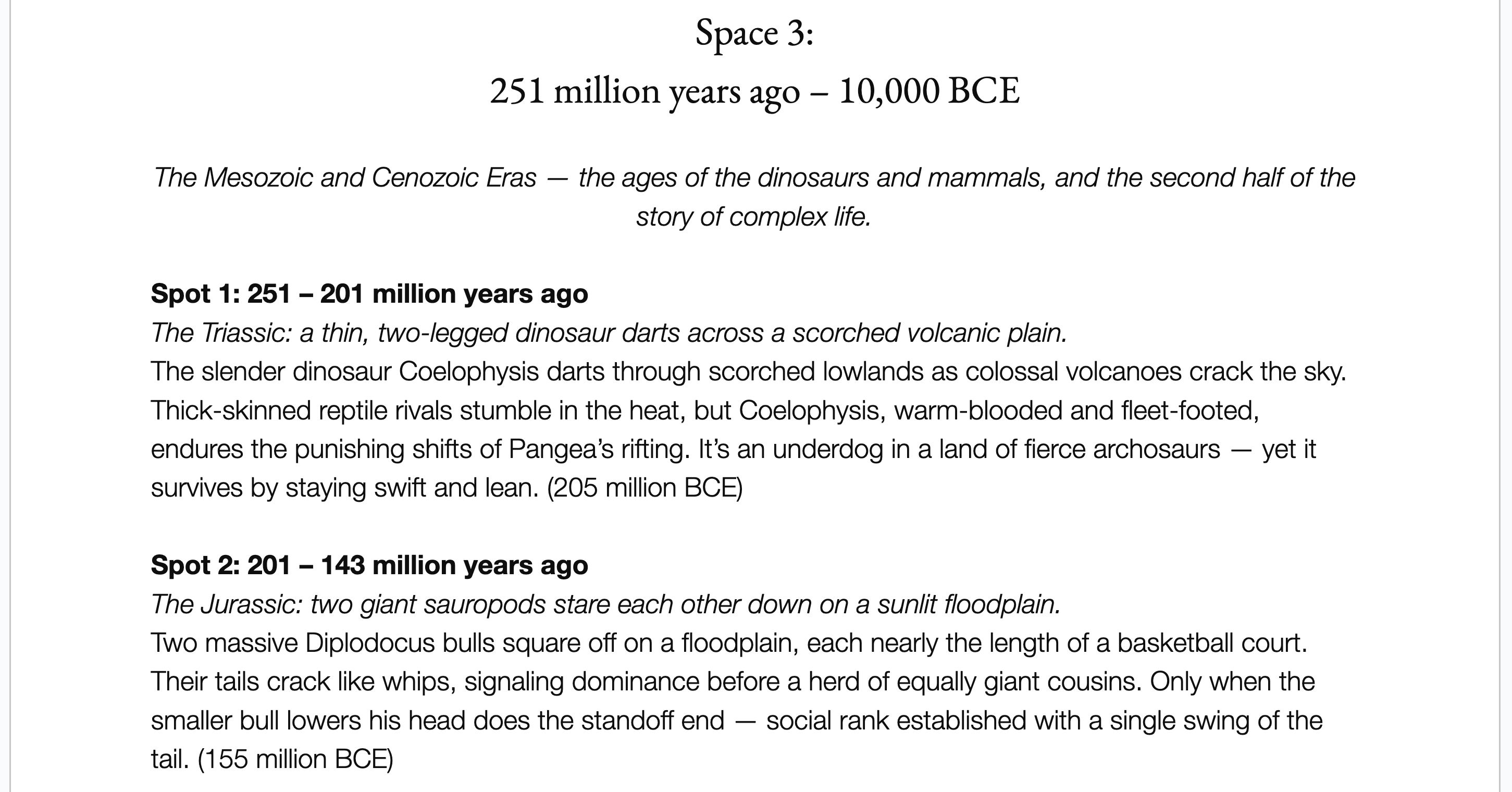
And here’s one from prehistory (which doesn’t give three stories for each spot, but who needs that when you have dinosaurs):
Again, I can’t emphasize enough how imperfect this list is, but if you’re looking for something to rip off someplace to start, this might be helpful! I’ll put a link at the bottom of this post for paid subscribers.
🧵Thread 2: History stories
How can you tell a compelling story? (Use AI!)
The next step, of course, is to actually compose a gripping, kid-friendly story for each of these ~100 events. But how can you do that?
Obviously, if you’d like to do the research for all of this, do! When you want to do a story on, say, Ashoka the Great, third-century ruler of the Maurya Empire, you can read his Wikipedia article, watch a YouTube video, and maybe peruse a book or two (some are for kids!). And then you can put it all together in a story custom-made for your kid.
Or you can have an AI do it. (Reading & putting together words, after all, are what we built LLMs to do in the first place.)
I.I.: I’m aghast! Offended! Storytelling is a high human calling; it shouldn’t be offshored to a machine.
Brother, I’m with you. And for what it’s worth, as our (still secret!) team works on a history curriculum, we’re committing to making it human-written.
But if you want a pretty-good story that you can use with your kids today, dang, an AI is a pretty useful tool. Again, even stupidly simple prompts can get you pretty far. Pasting this into even a free, not-connected-to-an-account ChatGPT window…
Act as a historian. Tell me a story about Ashoka the Great at a pivotal moment in his life.…got me a response that I’ll declare five times better than anything in my high school history textbook. (I’ll paste its response into this footnote.1)
Of course, you can do better with some prompting. To make it more accurate, you can ask it to begin by listing out historical details from its research. To make it a better storyteller, you can ask it to ground the story in the challenge the character faces, to show us the character’s personality through their choices, and to ground the whole thing in a suitable emotional binary.
And so on, and so on. Last summer I spent some time playing around with this and created a custom GPT into which I poured everything I know about historical storytelling, and as many public-domain history books I could get my hands on. I’ve shared it, and I’ll put the link to it after the subscribers-only break — note that you’ll need a ChatGPT account to use it (but not, I believe, a paid account).
If you type “Ashoka the Great” into it, it’ll give you…
the precise spot he should go in your memory palace,
where he lived (easy to find on a map),
some important art associated with him,
a 4-paragraph story that connects to his larger life and the broader historical narrative,
hints for how to imagine him physically,
a pronunciation guide,
philosophical discussion questions,
a vivid image to put on your wall, and
a bad poem, if that’s your thing.
Just typing in the name “Ashoka the Great” gave me this story2 and the rest of the above.
In sum
For most of human civilization, helping kids fall in love with history required a private library and years of reading. It was beyond the reach of almost any parent, which is why rich households hired aristocratic tutors — learned adults who had already done the reading, and could pass the best stories into children’s minds.
As Erik Hoel has argued, this practice was one of the engines of aristocratic achievement.
For the first time in history, that bottleneck is gone. We have AI!
The educational world is split between
A. people excited this will bring about the golden age of learning, and
B. people who fear it will dehumanize schools.
I’m on the side of both. My hope is that AI can supercharge our engagement with the curriculum — helping every teacher (and homeschooling parent) to speedrun the research so we can enter into vibrant intellectual experiences with our kids.
That is: fewer screens, richer stories, and deeper questions… all made possible by machines who have already done the reading.