


By the end of elementary school, every kid should be able to perform feats of mental arithmetic that others might call “freaky”.
This is our last post on elementary math. If we play our cards right, the two threads before — 🧵DAILY LESSONS and 🧵PUZZLES — should help kids cultivate both (1) a proficiency at math and (2) an affection for it.
Having put all this together, Alessandro and I thought: maybe that's enough! But then we asked ourselves: what if we wanted to go deeper? What could we do with this appreciation for the magic of numbers that our students will have? We concluded that we wanted kids to have them bring the power of numbers inside themselves.
To do this, we propose having a third thread of math: 🧵QUIXOTIC GOALS. In elementary school, this means fantastic feats of mental math.
Hold onto your butts; this is about to get strange. And we admit that while we’re in love with it, it might not be right for every kid. As you read this, ask yourself whether it seems approachable for your son or daughter (or, if you’re a teacher, your students), and register your hot take in the comments.
We could push this back to middle school… though that would mean that middle school’s 🧵QUIXOTIC GOAL of Fermi estimates and Bayesian fights would be pushed back to high school, and high school’s 🧵QUIXOTIC GOAL of Philosophy of math would disappear in a puff of smoke. So there’s a trade-off there, too.
Let’s dive into this one.
To state this clearly, by the end of fourth grade, our goal is to have helped our students calculate impressive sums, differences, products, and quotients without a calculator or pencil.
I.I.: This feels — what’s the word? — “stupid”. No, “abhorrent”. No, “evil”! (Help me out here, I’m no good with words.)
If this is forced on students, yes, all three of those are true. Our goal is to create the conditions so that (1) building these skills is straightforward, and (2) the kids want to do it (or at least don’t fight against it).
The trick to cultivate desire is to tap into kids’ sense of 🦹♂️THE HEROIC, and to show them what the human mind can do.
I.I.: I see by that emoji that “the heroic” comes from ROMANTIC (🦹♂️) understanding. Usually you associate that with middle school. Isn’t elementary a bit early for this?
Possibly — and if this isn’t right for your kid or class, then by all means hold this back until middle school. But we suspect there’s enough of a desire for heroism in little kids that we can start building this now. (And for what it’s worth, Egan was keen to emphasize that we don’t suddenly switch from one way of understanding to another as we grow, and that the seeds of each are with us at every age.)
I.I.: If I want to do this, how can I tap into this hunger for the heroic?
Show your kids that the human mind is amazing, and that with the proper practice individuals can achieve amazing things. Introduce them to quick videos of young kids performing freaky feats of mental math. Tell them that to learn this they don’t have to be naturally gifted at math, but that learning it will make them something akin to being gifted.
🧵MENTAL MATH, Practice A: Counting Rhymes°
We’ll start utterly simple. As stated above, our native 🧙♂️NUMBER SENSE sucks at numbers above three or four. But of course we want kids to learn to count! While they’re still young, we can teach kids various 🧙♂️RHYMES to lock patterns into their memories.
But this goes further than “one, two, buckle my shoe” — we can also use this for skip-counting to prepare the way for mental multiplication.
For more on this, see my earlier post Counting Rhymes°.
🧵MENTAL MATH, Practice B: 9-bead Abacus°
A basic abacus is an OG computer, but people mostly use them as rather chintzy home decor. If you remove just one bead from any 10-bead abacus, you make obvious its true power: each row is a “place” in the base-10 numbering system, and every configuration of an abacus literally displays a number.
To be fair, it’s actually pretty hard to remove the beads on a store-bought abacus; easier is to paint the left-most bead black and use it to “carry”. For more on this, see my earlier post Basic Abacus°.
🧵MENTAL MATH, Practice C: Finger Math°
Your fingers are mightier than they seem. If you know how to use them, they can give the answers to impressive calculations, and there are hints that using them is cognitively privileged — that it recruits extra parts of the brain.
We’ll teach this to prepare the way for the next type of abacus, which follows the patterns of finger math suspiciously closely. For more, see Finger Math°.
🧵MENTAL MATH, Practice D: 5-bead Abacus°
This is a finger calculator, but better — a tool for people who want to do arithmetic quickly and accurately and actually understand what’s happening. It’s the penultimate step before being able to do truly fantastic feats of mental math —
(Watch the fingers of the first kid fly.) For more on this, see Bead Computers°.
🧵MENTAL MATH, Practice E: The Grammar of Numbers°
Throughout, unveil the patterns that keep popping up when we do arithmetic. As always, start with the simple classics:
When you multiply by 10, the answer is always the original number with a “0” on the end:
4 × 10 = 40
5 × 10 = 50
When you multiply a one-digit number by 11, the answer is always the original number written twice:
4 × 11 = 44
7 × 11 = 77
I.I.: But this isn’t new. Everyone learns these.
Exactly! The dominant curriculum introduces these bits of mental math — and then drops them. All we’re suggesting is that we keep going. So make it slightly more complex by going to two-digit numbers:
When you multiply a two-digit number by 11, the answer will always have three digits. The first and last will stay the same; in the middle will be a new number… which will be their sum!
42 × 11 = 462 (6 is the sum of 4 and 2)
27 × 11 = 297 (9 is the sum of 2 and 7)
Whenever those two digits sum to 10 or more, the pattern continues — but you carry the “1”:
49 × 11 = 539 (13 is the sum of 4 and 9)
28 × 11 = 308 (10 is the sum of 2 and 8)
From there, it’s not too hard to move to numbers that are many digits long:
When you multiply a super-long number by 11, the answer will always have one more digit than before. The first and last will stay the same, but each number in the middle will be the sum of the pairs of adjacent digits:
1,234 × 11 = 13,574 (3 is the sum of 1 and 2…)
1,002,005,009 × 11 = 11,022,055,099 (1 is the sum of 1 and 0…)
I.I.: But where would you get the basic building blocks of the curriculum?
a well-made math curriculum is a complex machine, and people have invested their lives into making good ones. Rather than trying to invent our own, we’ll build on someone else’s.
That’s true here, too. Thankfully, the world abounds in mental math curriculums. If you’ve gone through one that you’d like to recommend (or to caution us away from) — or if you’d like to explore the options for us — let us know in the comments. (For the moment, I’ll assume Arthur Benjamin’s Secrets of Mental Math.)
Once that’s chosen, we can Eganize the heck out of it, starting with the concept ladders and boss problems we use in the 🧵DAILY LESSONS.
And then, perhaps, we can go further. More than anything else we teach in elementary school, this has the potential to really seem like arcane magic. So lean into that: treat these tricks as ancient 🧙♂️MYSTERIES. By 🧙♂️FINDING PATTERNS, kids can unveil them, and add their power to themselves. (In truth, this can be done in all the practices in this thread.)
Why mental math?
This deserves to be answered squarely. Imaginary Interlocutor, take it away!
I.I.: Who cares about this? Why is this worth anything? Haven’t you heard of calculators? This is old school to the point of parody; even mathematicians don’t learn to do mental math anymore. You’re letting your cottagecore aesthetics push out your common sense.
Four reasons, perhaps.
1. It makes all math easier
Arithmetic is, practically speaking, part of all the math we do in school; any middle schooler who still struggles with
will bang their head against the table when they see
The easier that we can make addition, subtraction, multiplication, and division, the more we can free students from pain.
2. It makes everyday math possible
If arithmetic is automatic for you, you’ll actually use it in everyday life. If it’s not, you won’t.
I.I.: “Everyday math” is a lie concocted by textbook companies to sell curriculum. No one actually uses math in real life.
If by “everyday math” you mean contrived word problems, you might be right:
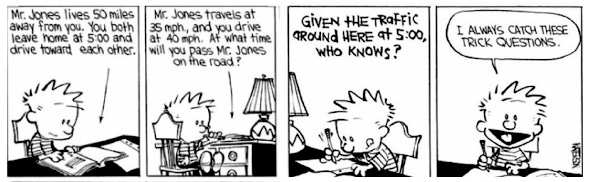
But elementary school math pops up constantly — adjusting a recipe, comparing prices, estimating times, and so forth. And when arithmetic is really easy, then all sorts of opportunities open up.
I.I.: But surely not enough opportunities to justify all this work.
Ordinarily, you might be right. But see if you still think so after you read the 🧵QUIXOTIC GOAL for middle school — Fermi estimates.
3. It turns elementary math into real intellectual food
It’s easy, I think, for a certain type of “math person” to look down their nose at arithmetic as “mere calculation”. Best (they think) to master it quickly and move on to the good stuff.
But arithmetic, understood properly, is as heady as anything in math.
To understand why, for example, the “11 trick” above works, you need to build a mental model of how numbers split and recombine across place values. That means that you need to have a deep appreciation for how our base 10 system works, which means that you need to understand how any base system can work.1
4. It makes you a wizard
Deep in our hearts, all of us want to be accosted by an 8-foot tall bearded man who proclaims, Yer a wizard, Harry!2 Like I said before, mental math is one of most direct routes into wizardry for young kids.
When we first learn to add, it’s effortful, and we get frustrated by screwing up. In normal schools, we move past that, and can (with some focus, and perhaps a pencil) get the answers right without too much suffering. We enter, that is, into tool-aided fluency.
But few people take the next logical step, and progress to automaticity.
effort → fluency → automaticity
And automaticity can feel amazing. There’s an ecstasy to it that’s difficult to put into words, but I’ll try it: you stop being a thing that’s doing math, and become the place where the math is happening. You feel that there’s great power swirling inside you, and finally you have a way to focus it.
And this, in the end, is why we think that every kid should have the opportunity to learn mental math. Alessandro and I get that this sounds strange. But what’s truly strange to us is that we do 90% of the work to learn math… and then stop before the last 10%, where it would become something truly powerful.
Next up: Middle school
We’d love to get your radically honest thoughts below; we’ll try to answer everything. In any case, we’ve now laid out what we’re going to do with math in elementary school, and are ready to turn to middle school.
Oh, that reminds me of a question — I’ve been trying an experiment of publishing each thread separately. How do you like it?
© 2026 losttools.org. CC BY 4.0
And if you think bases are intuitive, check out Justis Mills’ recent post on arithmetic with negative bases.
Particularly those of us named Harry.
This is more of a general question, but topic-relevant: Have you tried exploring what Claude or ChatGPT can create by way of age-appropriate math lessons? Both have made a serious effort in targeting STEM education and, in a matter of minutes, can create interactive lessons by guiding the educator through a series of questions to specify the learning objective. It's really worth exploring. I would imagine that this will also be very helpful for homeschoolers.
You'll probably mention this in the next post, but I think the best use of this kind of mental math is as a foundation for quick estimation.
That's also something that can grow with students as they learn more math, so it can provide an enduring thread throughout their math education.
Feynman had a lot of fun with these kinds of problems: https://math.stackexchange.com/questions/4837744/how-did-feynman-produce-solutions-in-under-a-minute
And it actually has some practical use too! For example, calculating cube roots in your head might seem pretty esoteric, but it's actually what you need to figure out how large of a box you would need to hold a stack of books.